
In this section:
- Behaviourist explanation for phobias: Mowrer’s two factor approach i.e. the combination of classical conditioning, followed by a reinforcement of the phobia through operant conditioning
- Behaviourist treatments for phobias: Joseph Wolpe’s systematic desensitisation – relaxation, fear hierarchy & exposure
- McGrath et al (1990) & Gilroy et al (2002) effectiveness of SD
- Flooding AKA exposure therapy
Behaviourist explanation of Phobias
Mowrer’s ‘two-factor’ approach.
This should sound familiar since we covered in year 12 with eating disorders. Mowrer believed that both classical and operant conditioning are involved in acquisition and maintenance of phobias.
Classical conditioning
Classical conditioning was originally founded by Pavlov. His famous study of conditioning a dog to salivate at the sound of a bell.

As we have seen with Little Albert and other studies, we initially learn fear by association. Classical conditioning therefore explains how we acquire the fear.
Classical conditioning works by associating something in which we initially have no fear of (NS) with something (UCS) that already triggers a fear response (UCR)
The NS (the rat) and the UCS (loud bang) were paired a number of times producing the UCR (crying/fear). Eventually, the presentation of the rat alone made Albert cry. This suggests that the NS (the rat) is now a Conditioned Stimulus (CS) and Albert’s crying is a Conditioned Response (CR).
This conditioning also generalised to similar objects such as a white rabbit, a fur coat and white cotton balls.
Real life example: Geraldine had a car accident on the corner of Cherry Avenue. Whenever she approaches the intersection, she begins to feel uncomfortable; her heart begins to beat faster, she gets butterflies in her stomach, and her palms become sweaty (she experiences anxiety/fear).
NS = Intersection UCS = Car Accident UCR = Anxiety (feel uncomfortable; heart racing, etc) because of accident CS = Intersection CR = Anxiety about intersection
Operant conditioning
Avoiding the fear-provoking stimulus then prevents us from unlearning the fear so as a result the fear is not extinguished. Operant conditioning therefore explains why a phobia is maintained.
Negative reinforcement is the removal of something unpleasant. Reinforcement encourages a behaviour, punishment discourages a behaviour. Be careful, as they are easily confused with each other.
Avoiding a situation or object that causes anxiety or fear is seen by behaviourists as negative reinforcement, because it is the removal of something unpleasant e.g. removing the feeling of anxiety. If you fear going to school, you will avoid going to school, and as a result feel less anxious. You then learn by avoiding school you will feel better, and therefore you feel encouraged to avoid school even more so!
Unfortunately this means that your fear will not be extinguished since the only way to lose a behaviour, in behaviourist terms, is by unlearning the association between fear and the stimulus that causes it.

Evaluation of the behaviourist explanation for Phobias
Strengths:
- Supporting research: There is some evidence to support the theory, particularly the case of Little Albert in Watsons study (1920) who clearly did acquire a phobia via classical conditioning and who did generalise it, as predicted by behaviourists, to similar objects such as rabbits.
- Usefulness: The behaviourist explanation has enabled researchers to understand that if a phobia is learned, it can be unlearned. The behaviourist approach has lead to the development of therapies such as Systematic Desensitisation. McGrath et al (1990) reported that 75% of patients with phobias respond to systematic desensitisation. It is most effective when used in vivo, the patient being exposed to the real stimulus rather than being asked to visualise or imagine their fear (in vitro).
- Scientific/Measurable: The behaviourist explanation focuses on observable behaviour, therefore this is more scientific as it can be measured more objectively. Typically, the behaviourist approach will use experiments to establish cause and effect, this is evidenced by the Little Albert experiment.
- Ethnocentrism – Cultural differences: Some phobias are very specific to a certain culture, for example Koro is a phobia that is specifically experienced by Asian males. It’s the fear of the genitals retracting into the body, eventually leading to death. The fact that some phobias are specific to the culture would support the idea that they are learned, as culture is something which is experienced through learning and upbringing within the environment.
Weaknesses:
- Individual differences: It takes a nomothetic approach which doesn’t account for individual differences. Not all people that have had frightening experiences of something go on to develop a phobia. This individual difference in susceptibility to acquiring phobias suggests that there could be other contributing factors such as genes, individual differences in personality types etc.
- Alternative explanations: Seligman (1971) believes we are predisposed to acquire some phobias rather than others. Learning to be frightened of snakes and spiders might once have conferred an evolutionary advantage. Therefore, the extent to which we learn phobias may be determined by our biology – this theory was known as biological preparedness. However, this may explain fears, but does not necessarily explain phobias. Phobias a lot more extreme then a fear as they disrupt everyday life and can be seriously debilitating for the individual.
- Alternate explanation: This theory takes a complex behaviour in very simple terms. It isolates a traumatic experience and tries to isolate this contribution towards the phobia. There are likely to be a complex interaction of factors that could explain a phobia. For example, there are also cognitive symptoms to phobias such as the cognitive distortions and irrational beliefs that simply cannot be explained by the behaviourist model. For example, Tomarken et al (1989) showed people with snake phobias slides of snakes and neutral objects and asked how many snakes, trees etc, that there had been. Snake phobics over-estimated the number of snakes compared to the control group. This shows the role of of distorted thinking, which the behaviourist explanation neglects.
- Application issues: Sometimes phobias develop and the individual has no awareness of any bad experiences of the thing they fear. For example, I could be scared of elephants, but I’ve never met one, or been frightened by one. Therefore, this explanation is limited.
- Opposing research: Barlow & Durand (1995) reported that 50% of people with a phobia for driving could remember a specific incident that had triggered their fear, again supporting the theory that phobias are learned. However, about 50% of people with phobias cannot recall a specific event that triggered the fear.
Behaviourist treatments for phobias
Abnormal behaviour has been learned (according to behaviourists) then treatment concentrates on unlearning inappropriate behaviour and replacing it with the learning of new behaviours.

Systematic desensitisation by Joseph Wolpe
Behaviour therapies (based on classical conditioning)
These are often used to treat phobias and involve the patient learning (that word again) to associate (that word again too) their phobic stimulus (spider or whatever) with relaxation.
- Relaxation: The patient is first taught a muscle relaxation technique or meditation. This usually involves being aware of breathing and imagining oneself in a very relaxing situation.
- Fear hierarchy: The therapist and patient construct a hierarchy of anxiety starting with what the patient finds least anxiety provoking and building up to most anxiety provoking.
- Exposure: Over a number of sessions the patient practices their relaxation technique whilst working their way up the fear hierarchy. At each stage the therapist will ensure that the patient achieves a sense of calm before they move on to the next stage. Treatment is complete once they can stay relaxed at the highest level of the hierarchy.
The role of the analyst is also important since they need to recognise the reason for the fear. Sometimes this may be irrational but there may also be logical reasons for the fear and these need to be dealt with too.
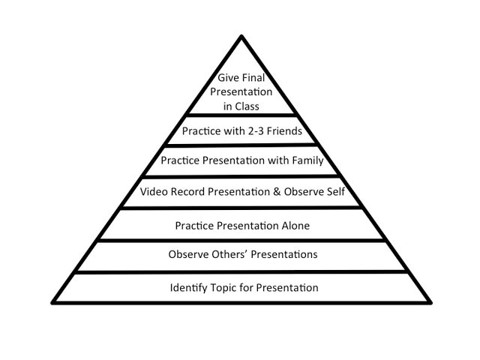
See below an example of a fear hierarchy:
Evaluation of Systematic Desensitisation
Strengths:
- Usefulness: SD is an effective therapy with patients showing much greater recovery than with no therapy. McGrath et al (1990) reported that 75% of patients with phobias respond to systematic desensitisation. It is most effective when used in vivo, the patient being exposed to the real stimulus rather than being asked to visualise or imagine their fear (in vitro). In addition, the relaxation technique ensures that the patient should never be exposed to stress. Therefore, SD is appropriate for all age groups and for people with a range of medical conditions.
- Longitudinal research: Lang et al. (1963) used systematic desensitization with a group of college students who were all suffering from a snake phobia. They underwent 11 sessions to work through a hierarchy. Hypnosis was used to assist in the maintenance of relaxation. The P’s fear rating fell and improvements were still evident 6 months later. This shows that SD has long lasting effects and this has benefits to the economy as the patient will not need to return for further treatment. In addition, the fear hierarchy is also developed by the patient and is therefore personalised to them and gives the patient a sense of control.
Weaknesses:
- Usefulness: Phobias that may have an adaptive predisposition such as fear of heights or the dark are generally more resistant to SD, therefore this treatment may not be useful in treating all types of phobias.
- Usefulness: Systematic desensitisation is a slow process, taking on average 6-8 sessions. This may not be useful in treating phobias to a large number of individuals. It requires a trained professional and a number of hours, therefore it is time consuming and costly.
- Lacks a holistic approach: SD treats the observable and measurable symptoms of a phobia. This is a significant weakness because cognition’s, emotions and associations often influence phobias in combination. Therefore, the treatment may only target behavioural symptoms, not the underlying cognitions that are internal. A patient could act that they are ok on the outside, but cognitively, they may still have irrational thoughts which could maintain the phobia.
Flooding AKA Exposure Therapy
Imagine having the worst fear of spiders, and then being locked in a room full of spiders. The theory is that the person suffers massive panic but that this can only last so long. The adrenal response is short lived and soon the person calms down due to lack of adrenaline. Hopefully in future they will associate this chilled response with spiders rather than associating spiders with fear.

Sometimes flooding does incorporate a relaxation technique, but this is not always the case.
Like SD it can be used in vivo with actual exposure to the stimulus of fear as you can see above. It can also be used in vitro with the exposure being imagined.
Evaluation of Flooding:
Strengths:
- Usefulness – effectiveness: Wolpe (1960) used flooding to remove a girl’s phobia of being in cars. The girl was put into a car and driven around for 4 hours until for calmed down. This demonstrates the effectiveness of the treatment. Can you think of the issues of using one participant to support an explanation? Application: Flooding has been used to treat specific phobias such as fear of clowns, fear or snakes etc and has shown success.
- Usefulness: However, it is time and cost effective. Although the exposure may take a few hours, it only requires one session rather than the many that may be involved in SD. As we can see from the Wolpe study, flooding is a rapid treatment that delivers rapid and immediate improvements.
Weaknesses:
- Usefulness:There would be issues using flooding for the elderly or for those with heart conditions. Flooding is also a traumatic experience so it is vital the process is fully explained in advance so patients can give their full informed consent. Flooding cannot force someone to face the phobia and they must be able to withdraw. This mean mean that the anxiety worsens and the phobia is then reinforced further because the patient did not complete the flooding treatment i.e. didn’t wait until they were calm.
- Application: It isn’t suitable for social phobias and is likely to make these conditions worse, probably due to the cognitive elements and embarrassment involved in such phobias.
- Alternative treatments: Research has shown that other treatments can be successful in treating phobias. Cognitive Behavioural therapy has been shown to be successful in a range of disorders including phobias. Biological research has also found that SSRI’s and MAOI inhibitors have been used to effectively reduce social anxiety and social avoidance phobias. This highlights an issue with behaviourist treatments, this is because it does nor target all potential causes of the phobia. Therefore, behaviourists treatments may not work for all individuals. For example, if it is a chemical imbalance that is creating anxiety, no amount of behaviourist therapy would be successful because it isn’t targeting biological influences.
 CGS Psychology Blog: Mrs Harris