
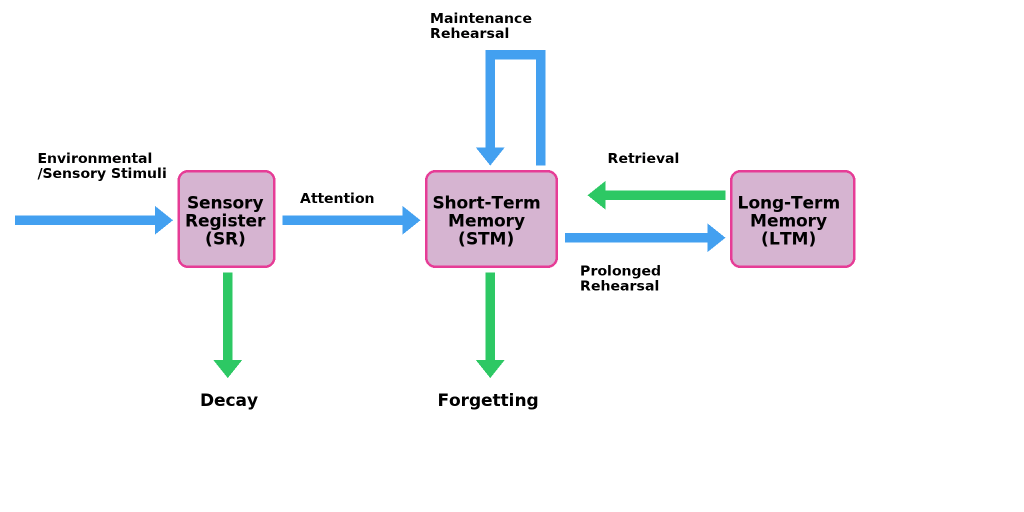
Sensory Register:
The SR is where information from the senses (sight, sound, smell, touch and taste) is stored, but only for a duration of approximately half a second before it is forgotten.
- Duration: ¼ to ½ second
- Capacity: all sensory experience (very larger capacity)
- Coding: sense specific (e.g. different stores for each sense e.g. if you see something that is encoded by the sight sense, if you eat something that is encoded by the taste sense) The two main stores are echoic memory – sound that is coded acoustically, and iconic memory – visual information that is coded visually.
Key study for Coding of the Sensory Register: Sperling (1960:
Sperling (1960) presented participants with a 3 × 4 grid of 12 letters for approximately 50 milliseconds. Participants were asked to focus on a fixation point before the display appeared. After the grid disappeared, they were asked to recall as many letters as possible.
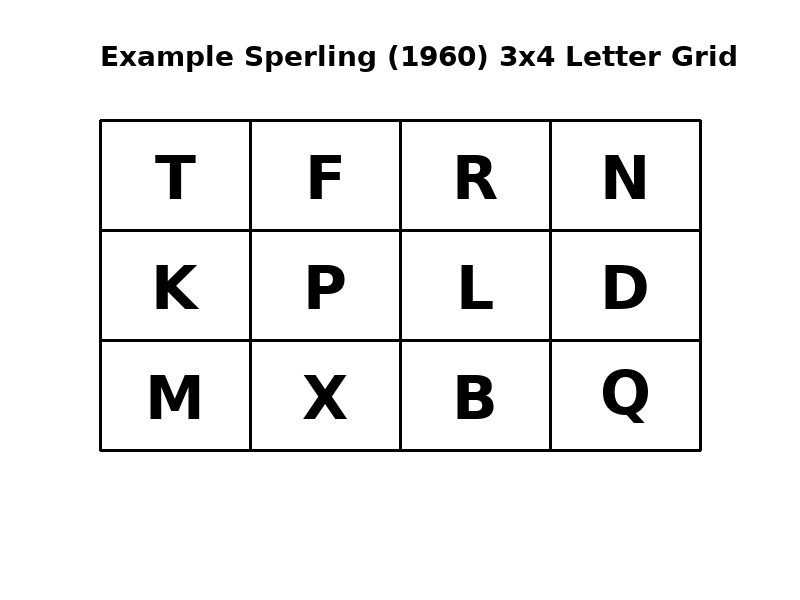
In the whole report condition, participants attempted to recall all 12 letters. On average, they recalled only about 4–5 letters.
In the partial report condition, participants saw another grid of 12 letters. Immediately after the display disappeared, a high-, medium-, or low-pitched tone was played. The tone indicated whether participants should recall the top, middle, or bottom row of letters.
Results:
- Whole report: approximately 4–5 out of 12 letters recalled.
- Partial report: approximately 3 out of 4 letters recalled from the specified row.
Conclusion:
Participants were able to recall most of a row when asked immediately after the display disappeared, suggesting that they had briefly stored almost all of the visual information in iconic memory. However, the information faded very rapidly before it could be reported.
This suggests that:
- The sensory register has a very large capacity.
- The duration of iconic memory is very short (around 0.25–0.5 seconds).
- Information in the sensory register is coded in a sense-specific way (visual information in iconic memory, auditory information in echoic memory).
Short-term Memory:
We don’t always pay attention to all of the information that is around us, therefore the info that is ignored would not move any further in the MSM. However, if attended to, sensory information moves into the STM for temporary storage, which will be encoded visually (as an image), acoustically (as a sound) or, less often, semantically (through its meaning).
STM is thought to have a capacity of 5-9 items and duration of approximately 30 seconds. This capacity can be increased through ‘chunking’, for example converting a string of items into a number of larger ‘chunks’. A good example is when we are trying to learn a mobile phone number: 01494324654, we may chunk the aerial code 01494, and then the rest of the number in chunks of three i.e. 324, 654.
- Duration: 18-30 seconds
- Capacity: 7 +/- 2 items – this means that the average capacity is 7, 5, or 9
- Coding: mainly acoustic
Rehearsing information via maintenance rehearsal (when we repeat the information to ourselves over and over again) helps to retain information in the STM, If we rehearse it for long enough it passes into LTM. If information is not rehearsed, it is forgotten and displaced after around 30 seconds.
Key Study for the Duration of STM: Peterson & Peterson (1959)
Peterson and Peterson investigated the duration of short-term memory (STM). Participants were presented with a trigram (a meaningless combination of three consonants), such as:
- TYF
- GHW
- SDT
The participants were then given a three-digit number and asked to count backwards in threes from that number. This was an interference task designed to prevent them from rehearsing the trigram.
For example:
- Trigram: TYF
- Starting number: 364
- Participant counts backwards: 361, 358, 355, 352…
Participants were asked to stop counting after different time intervals, ranging from 3 to 18 seconds, and then recall the original trigram.
Results:
Recall was very high after short intervals but decreased rapidly as the delay increased.
- About 80% of trigrams were recalled correctly after 3 seconds.
- Recall fell to about 3% after 18 seconds.
Conclusion:
Peterson and Peterson concluded that without rehearsal, information in STM lasts only about 18–30 seconds before it is forgotten. This suggests that rehearsal is necessary to maintain information in short-term memory.
Key Study for Capacity of STM: Jacobs (1887)
Jacobs used a digit span test to investigate the capacity of short-term memory. Participants were presented with a sequence of digits or letters and were required to recall them immediately in the same order. The sequences gradually increased in length until participants could no longer recall them correctly.
For example: X N J P T C B D L Y Q H OR 4 6 9 2 7 3 1 8 2 9 5
Jacobs found that participants could recall an average of 9.3 digits but only 7.3 letters. He also found that memory span increased with age.
Miller (1956)
Miller reviewed research into memory capacity and proposed that STM can hold approximately 7 ± 2 items. He suggested that capacity can be increased through chunking, whereby individual pieces of information are grouped into meaningful units. For example, the letters BBC ITV UK may be remembered as three chunks rather than eight separate letters.
Conclusion:
Research by Jacobs and Miller suggests that STM has a limited capacity of approximately 5–9 items, although this capacity may be increased through chunking.
Key study for Coding in STM and LT: Baddeley
Baddeley investigated whether information is coded according to its sound (acoustic coding) or its meaning (semantic coding) in short-term memory (STM) and long-term memory (LTM). Participants learned lists of words that were either:
- Acoustically similar (e.g., cat, mat, cap, map)
- Acoustically dissimilar (e.g., dog, bin, cup, pen)
- Semantically similar (e.g., big, large, huge, vast)
- Semantically dissimilar (e.g., huge, good, light, blue)
For the STM task, participants recalled the words immediately after presentation. For the LTM task, recall occurred after a delay of around 20 minutes. Researchers recorded the number of recall errors made.
Findings:
Short-Term Memory (STM)
- Participants made significantly more errors when recalling acoustically similar words than acoustically different words.
- Similar-sounding items were often confused with one another.
- This suggests that information in STM is mainly coded acoustically (by sound).
Long-Term Memory (LTM)
- Participants made more errors when recalling semantically similar words than semantically different words.
- Words with similar meanings were more likely to be confused after the delay.
- This suggests that information in LTM is mainly coded semantically (by meaning).
Conclusion:
- STM primarily uses acoustic coding, so similar-sounding information is easily confused.
- LTM primarily uses semantic coding, so information with similar meanings is more likely to be confused
Sensory Register:
The SR is where information from the senses (sight, sound, smell, touch and taste) is stored, but only for a duration of approximately half a second before it is forgotten.
- Duration: ¼ to ½ second
- Capacity: all sensory experience (very larger capacity)
- Coding: sense specific (e.g. different stores for each sense e.g. if you see something that is encoded by the sight sense, if you eat something that is encoded by the taste sense) The two main stores are echoic memory – sound that is coded acoustically, and iconic memory – visual information that is coded visually.
Key study for Coding of the Sensory Register:
Sperling (1960) presented students with a 3×4 grid which contained a mixture if letters and numbers. He asked participants to stare at a blue cross on a screen. The table of 12 letters and numbers flashed up for 50 milliseconds (a blink of an eye). They were then asked to write down as many of the letters and numbers as they could
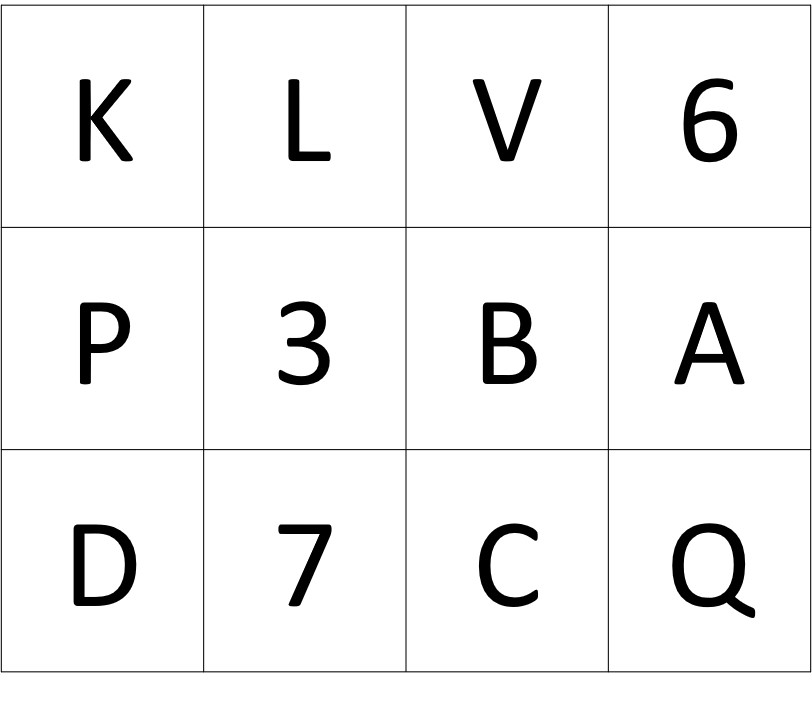
The same participants were then shown a different table of letters and numbers, however this time after the grid had gone, the researcher called up ‘high’, ‘middle’ or ‘low’. Participants were required to recall only the letters in the row I specify.
Results:
Mean averages:
- Whole grid = 5/12 items recalled on average
- One Row = 3/4 items recalled on average
Theoretically participants should have been able to remember 4 items from a row, however approximately only 3 were remembered. This suggests that sensory memory cannot hold information for long, it decays rapidly in the sensory store: ¼ – ½ a second! This supports the existence of a sensory store!
Short-term Memory:
We don’t always pay attention to all of the information that is around us, therefore the info that is ignored would not move any further in the MSM. However, if attended to, sensory information moves into the STM for temporary storage, which will be encoded visually (as an image), acoustically (as a sound) or, less often, semantically (through its meaning).
STM is thought to have a capacity of 5-9 items and duration of approximately 30 seconds. This capacity can be increased through ‘chunking’, for example converting a string of items into a number of larger ‘chunks’. A good example is when we are trying to learn a mobile phone number: 01494324654, we may chunk the aerial code 01494, and then the rest of the number in chunks of three i.e. 324, 654.
- Duration: 18-30 seconds
- Capacity: 7 +/- 2 items – this means that the average capacity is 7, 5, or 9
- Coding: mainly acoustic
Rehearsing information via maintenance rehearsal (when we repeat the information to ourselves over and over again) helps to retain information in the STM, If we rehearse it for long enough it passes into LTM. If information is not rehearsed is forgotten and displaced after around 30 seconds.
Key study for Duration of STM:
The duration of the short term memory was measured using the Peterson & Peterson (1959) technique. Participants were given trigrams which they had to recall after varying amounts of time from 0-18 seconds.
Examples of trigrams: TYF, GHW, SDT
They had to then do an interference task to prevent the participants from rehearsing. They did this by giving them a number that they had to count down from until they were told to stop. for example they could be given the number 56, and then have to count down, 55, 54, 53, 52 STOP!
Participants were asked to stop counting down after various amounts of time.
| Nonsense Trigram | Count backwards from | Number of seconds | Retention Interval |
| WRT | 303 | 3 | 300 |
| TGK | 476 | 15 | 461 |
| JDL | 289 | 6 | 283 |
| WPB | 495 | 18 | 477 |
| GPS | 628 | 12 | 616 |
| DKC | 675 | 9 | 666 |
| MPL | 382 | 18 | 364 |
They found that only 10% of the trigrams were recalled after 18 seconds, this being the new, average duration of the short term memory, therefore our memories are very short lived according to Brown-Peterson.
Key study for Capacity of STM:
Experiments that investigate capacity traditionally use the serial digit span method in which numbers/letters etc have to recalled in the correct order. Find out what your digit span is here: https://www.cambridgebrainsciences.com/science/tasks/digit-span
Jacobs (1887) conducted an experiment using a digit span test, to examine the capacity of short-term memory for numbers and letters. Jacobs used a sample of 443 female students (aged from 8-19) from the North London Collegiate School. Participants were given a string of numbers or letters in the same order in which they had to recall immediately. The number of digits/letters was gradually increased, until the participants could no longer recall the sequence.
For example: X N J P T C B D L Y Q H
Jacobs found a difference between capacity for numbers and for letters. On average participants could recall 9 numbers but only 7 letters. He also noticed that recall seemed to increase with age.
Jacobs concluded that STM has a capacity of between 5 and 9 (7 +/-2) items of information and as age increases we appear to develop better strategies of recall.
Miller (1956)
Theorised that because we have so many things in 7’s in out lives, that our capacity must be 7 items e.g. 7 days of the week and 7 deadly sins. Miller, also believed that you could recall 5 words as well as they can recall 5 letters. They can achieve this be using a process of chunking i.e. learning longer pieces of info by grouping them into small chunks.
Key study for the Coding of STM & LTM:
The key study here can be used for STM and for LTM since it investigated both.
Baddeley (1966) Participants were given four sets of words to recall in order. For the STM task they had to recall them immediately following presentation and for the LTM task they had to be recalled following a longer time interval.
- Set 1 were words that all sounded similar, for example: cat, mat, cap, map…
- Set 2 were words that sounded differently for example: dog, bin, cup, pen….
- Set 3 were words of similar meaning for example: big, large, huge, vast…
- Set 4 were words of different meaning for example: huge, good, light, blue….
The researchers then recorded how many mistakes were made in recalling the sets of words.
In the STM procedure participants made significantly more mistakes on words that sounded alike, so for example, would confuse cat and cap etc. Similarly with letters, S and X would be confused as would M and N and P and B etc. It was concluded that in STM information is coded by its sound (acoustically) so when we recall information from STM similar sounding words get confused. It was concluded that in STM information is coded by its sound (acoustically) similar sounding words get easily confused whilst you try and rehearse them in your head.
Long-term Memory:
This is seen as a permanent memory store, something you ideally want for all the material in your Psychology A level course ;-). It is also theorised that information in the LTM is predominantly encoded semantically. This means you have an understanding of it and therefore it is remembered, they tend to be general facts and knowledge i.e. you understand that football is a sport, you understand how to calculate algebra because you understand the steps and the logically outcomes of each step.
- Duration: Potentially a lifetime
- Capacity: Unlimited
- Coding: Mainly Semantic (but can be visual and auditory)
It is important to note that when we recall info that is stored in LTM, it has to be transferred back to the STM by a process called retrieval. According to the Multi-Store Model, information must first be retrieved from LTM back into STM before it can enter conscious awareness.
Key Study for the Duration of LTM: Bahrick et al. (1975)
Bahrick et al. (1975) investigated the duration of long-term memory by studying 392 participants aged between 17 and 74 years. Participants were tested on their memory of former high school classmates. The researchers used several memory tests, including:
- Free recall of classmates’ names
- Recognition of classmates from photographs
- Name recognition tests
- Photo-matching tests
Yearbooks were used to check the accuracy of participants’ memories.
Results:
- Participants who had left school within the previous 15 years correctly recognised approximately 90% of names and faces.
- Even participants who had left school 48 years earlier could still recognise about 70% of faces and names.
Conclusion:
Bahrick et al. concluded that information can remain in long-term memory for decades, suggesting that the duration of LTM may be potentially lifelong.
Here is an example of the MSM in action:
Sensory Register: You are in a lesson listening to me blabber on about Psychology, you can see my PowerPoint on the board and you can hear my voice, these are encoded in the sight and sound stores.
Short-term Memory: You haven’t paid attention to all the information in my lesson and some of it goes in one ear and out the other, it is forgotten and displaced. However, when I start telling you a memory strategy on how to remember the ethics in Psychology, this helps you to chunk the information and helps you to remember it. You then go over PADDI WAC in your notes outside of lesson – maintenance rehearsal.
Long-term Memory: When you return to my next lesson, I ask you to recall all of PADDI WAC, and you do this very successfully by transferring this memory into your STM. This is because you have a semantic understanding of the information and it is now a permanent memory.
Evaluating Research in the MSM – Research: GRAVER
- Validity: The Bahrick study was poorly controlled. The researchers assumed that last contact with their classmates would have been when they left school. Little consideration seems to have been made of participants seeing classmates in the intervening years or even of them having looked through yearbooks themselves!
- Ecological validity: In the Peterson study, the task was quite artificial as they were learning trigrams, which are not usually something we learn in our day to day lives. Therefore, it may be difficult to generalise to real life i.e. lacks ecological validity. Baddeley also acks ecological validity, the word list had no personal meaning to them so this may not be reflective of how participants code STM in real situations such as a conversation or learning during a lesson at school.
- Reliability: It uses a highly controlled lab experiment with the use of two conditions, LTM and STM, it has reliable and standardised procedures by presenting the same sets of words to each participant. This helps to replicate the study in order to check for consistent findings.
- Applications: Jacobs has useful applications. If we understand that we have a limited capacity, then we can be mindful about how much content we can memorise at a time, and as a consequence improve memory recall.
- Bahrick had high ecological validity as the procedure used a field experiment so is based on actual long-term memories that the participants had. They would have had meaning and purpose compared to artificial number and letter recall tasks.
- There is high control in Peterson’s study, use of artificial trigram tasks means that it could be standardised to establish a comparison between the groups and therefore cause and effect.
Evaluation of the MSM – Theory: SAUNDERS
Strengths:
- Supporting research: There is a large base of research that supports the idea of distinct STM and LTM systems as outlined in the MSM of memory e.g. Baddeley. The classic case is that of Henry Molaison (HM). When HM was 9 years old he was involved in a cycling accident. He recovered and appeared fine, until he stared having fits. This was diagnosed as epilepsy. HM was ridiculed and neglected by his family, as they believed that his fits and unusual behaviour brought shame on to the family. Medication was not working to resolve his condition and so, at the age of 27, he underwent surgery in an attempt to cure his epilepsy. A surgeon, William Scoville removed both his temporal lobes including a structure known as the hippocampus, and an area now known to be crucial to memory. He could remember some things — scenes from his childhood, some facts about his parents, and historical events that occurred before his surgery — but he was unable to form new memories. This case supported the MSM as, there were many attempts to move HM’s STM to his LTM, but it never happened. Therefore, there must be two different areas of the brain responsible for the STM and LTM.
- Supporting research – Baddeley, supports the MSM, because his study evidences a separation as it shows that STM is coded acoustic, whereas LTM is coded semantic.
- Support from amnesia patients – Clinical cases, such as HM, provide evidence for separate memory stores. HM could remember information for a short time but struggled to form new long-term memories after surgery. This suggests that STM and LTM are separate systems, supporting the MSM.
- Usefulness – The MSM was a pioneering model of memory that inspired further research and consequently other influential models, such as the Working Memory Model by Baddeley and Hitch.
- Alternative explanation – Craik & Watkins disagree with the MSM’s belief that rehearsal is important in terms of how many times the info is rehearsed. They believed that this was too simplistic, and that the type of rehearsal was far more important. They found two different types of rehearsal; maintenance rehearsal as described in the MSM, but this doesn’t transfer info to the LTM, it simply maintains in it the STM, hence the name maintenance. However, elaborative rehearsal is needed in order for info to be processed into LTM. This is when you connect the information to your existing knowledge, or you think about what it means. For example, when we are learning new things in psychology, I may try to get you to think of examples of it in you own lives. This is because research suggests that it helps you to store this information in your LTM :-). This challenges the MSM because the model assumes that the more information is rehearsed, the more likely it is to enter LTM. Craik and Watkins showed that the type of rehearsal is more important than the amount of rehearsal.
- Reductionist – Reductionist – The MSM oversimplifies memory by assuming that STM and LTM are unitary stores. Research suggests that LTM can be divided into episodic, semantic and procedural memory, while STM may consist of several components as proposed by the Working Memory Model.
- Support and Conflict: Evidence from neuropsychology – KF suffered brain damage following a motorcycle accident and had severely impaired STM but relatively intact LTM. This supports the MSM’s claim that STM and LTM are separate stores. However, KF could still process some visual information in STM, whilst verbal and auditory STM were impaired. This suggests that STM is not a single store, as proposed by the MSM.

