
As I’m sure you are aware, the body does lots of really amazing complicated stuff. It fights off infections whenever you feel unwell, it extracts energy out of the food you eat and, according to the biological explanation of behaviour, it tells you how to behave to ensure your survival. Metaphorically speaking you could think of your body as a bit like a (sometimes) well running country or army. Now, to be able to keep this army running effectively, there is going to have to be a system of communication to ensure that all divisions of the army are working towards the same aim. This communication system needs to be quick to accommodate any rapid changes in the environment (temperature, approaching threat, depleted resources). The communication system also needs to be able to bring about long-term changes if they are needed. To cope with these changes your body uses the two communication systems – the nervous system and the endocrine system.
The nervous system
First, think back to your biology GCSE. Here is a recap:
You have a central nervous system made up of your brain + spinal cord. The job of the CNS is to monitor your environment, and coordinate all your responses. So that you respond/behave in an appropriate way and stay alive. How does the CNS do that? Well it receives lots of information, all the time, about what is going on in your environment. Your CNS processes all this environmental information, and also uses information from within the brain such as memory. It uses all this information and determines an appropriate response.
This information is sent to the CNS from all over your body, by your sensory neurones. These are specialist cells, and you have them all over your body but especially in your sensory organs. At the end of every sensory neurone there is a receptor region of some kind. For example, at the back of your eye you have light receptors. In the lining of your stomach you have stretch receptors. In your nasal passages you have receptors that detect airborne chemicals. In your skin you have pressure receptors. In your skin you also have temperature receptors. One receptor = one job. For example, in a small patch of skin you will have some temperature receptors, and some pressure receptors. If the skin gets hot, the temperature receptors will generate an electrical impulse, and send it along their sensory neurones towards your CNS. Each sensory neurone is very long – it has a receptor at one end and at the other end it makes a connection with the CNS.
So there is lots and lots of information coming in to the CNS all the time. The CNS uses this information to coordinate a response. The response can’t be carried out by the CNS though – it doesn’t have any muscles or anything like that! But it tells the rest of your body what to do. It has ready-made connections to all your muscles and glands. These connections are called motor neurones. They carry information away from the CNS.
Sensory neurone = one-way information entering the CNS
CNS = brain + spinal cord = processes all the incoming information, integrates it with memories etc to determine response
Motor neurone = one-way information leaving the CNS
Let’s put this into a biological example: you put your hand on a really hot plate.
- Your hand touches the hot plate.
- Heat is detected by temperature receptors in the skin.
- Electrical signals are sent via sensory neurones to the CNS.
- Your CNS processes this information.
- Electrical signals are sent via motor neurones to the muscles of your arm and hand.
- You take your hand off the hot plate.
- Problem solved!
And that’s the end of your GCSE revision!
We are going to move on and find out more about the nervous system. It’s actually more complex than you learned at GCSE. It has subdivisions, and each has different roles and responsibilities. You can find a breakdown of that system below;

Central nervous system (CNS):
As stated above, this is the umbrella term for the spinal cord and brain. These are delicate, important organs. They are encased in bone to help keep them safe. The brain is inside the cranium (skull) and the spinal cord is protected by the vertebrae (backbone). The brain is where all incoming information ends up. It is also the storehouse of memories, language capability, etc.
There are nerves bringing information to and from the CNS. Some nerves enter the brain directly (eg the optic nerves) and others enter the spinal cord (eg the nerves from your arms and legs).
Peripheral nervous system (PNS):
So, if you have the brain and spinal cord as the centre of your body, anything outside of these areas is non-central or peripheral. I remember this by thinking about ‘peripheral vision’, which means everything around the outside edge of your vision. The PNS has two main subdivisions: the somatic nervous system (SNS) and the autonomic nervous system (ANS).
The SNS is made of all the nerves that control your musculoskeletal system, so this is the system that is used for voluntary movements. The SNS also includes all the nerves that carry information from your sensory receptors (what you are feeling, hearing, smelling, tasting and seeing at all times).
The ANS is essentially a separate set of nerves, and they control involuntary muscles and glands. They are responsible for ensuring the activity of your organs and vital functions such breathing rate, digestion and heart rate.
Let’s revisit our example from above, with the added systems in bold:
- Your hand touches the hot plate.
- Heat is detected by temperature receptors in the skin (peripheral – somatic)
- Electrical signals are sent via sensory neurones to the CNS (peripheral – somatic)
- Your CNS processes this information (central)
- Electrical signals are sent via motor neurones to the muscles of your arm and hand (peripheral – somatic)
- You take your hand off the hot plate.
- Problem solved!
One final complication: there are subdivisions in the autonomic nervous system. Remember, this is the system of nerves that controls all your involuntary muscles and glands, which means that overall the ANS controls the activity levels of your organs and your body. Examples of involuntary muscles: the heart, the breathing muscles, the muscles in your blood vessels that control blood pressure and blood flow, the muscles that move food through your gut, etc etc. So the ANS is very important. There are two subdivisions in the ANS: parasympathetic and sympathetic.
Parasympathetic nerves carry messages that put your bodily activity on to ‘rest’ settings. For example, parasympathic nerves slow down your heart rate, slow down your breathing rate, and increase blood flowto the gut. This is why it is sometimes called the ‘rest and digest’ system. These nerves are active when you are safe, and at rest. P = parasympathetic = ‘peace’

On the other hand, sympathetic nerves carry messages that put your bodily activity on to ‘high alert’ settings. For example, sympathetic nerves increase your heart rate, reduce blood flow to the gut, and cause your adrenal glands to release adrenaline. These nerves are active when you need to be ready for a burst of activity. S = sympathetic = ‘stress’
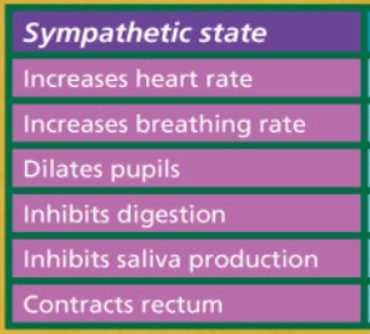
It’s important to understand that these are two parallel sets of nerves in the ANS. For example, your heart has both a sympathetic nerve and a parasympathetic nerve going to it. Your heart rate is decided by the relative activity of these two nerves.
Overall the ANS makes sure that you maximise your chances of survival.
I’m going to use the metaphor of the body being run like an army. Say there is suddenly a opposition army about to attack. The army generals are not going to be worried about the cook continuing to cook tonight’s dinner, or about having reserve troops on duty ploughing the fields. They are going to want to use all their soldiers to ensure optimal survival and defeat of the threat. This is what your body is doing. You don’t need to continue digesting food or producing saliva as this is wasting energy on something that won’t help in this situation. To continue the metaphor, when there is an attack the army generals ensure that their soldiers are well armed so they can fight back. Similarly, your body increases your heart rate and breathing rate, to increase the flow of oxygenated blood to your muscles, to give you a better chance of successfully fighting or running away.
Once the threat has been avoided or defeated, your CNS changes the activity of the ANS. When it is safe to rest again your parasympathetic nerves will take over again.
The endocrine system
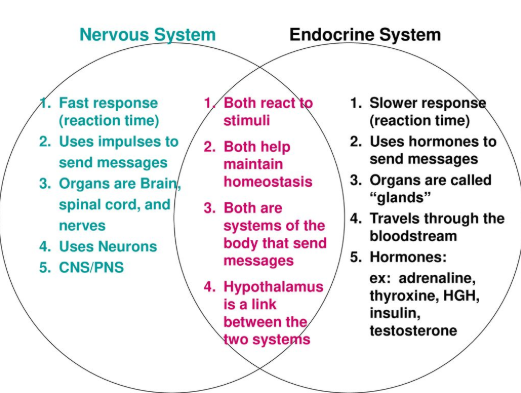
The endocrine system is another system within your body that sends messages, and just like with the nervous system these messages bring about changes in your bodily activity and behaviour.
However, this system works through the bloodstream instead of nerves. The picture below shows the different glands in the body. Each gland releases one or more hormones. The hormones are released into the bloodstream and then travel throughout the body. Each hormone has an effect on specific target organ(s) in the body. Each hormone has an effect on some aspect of your bodily activity or behaviour.
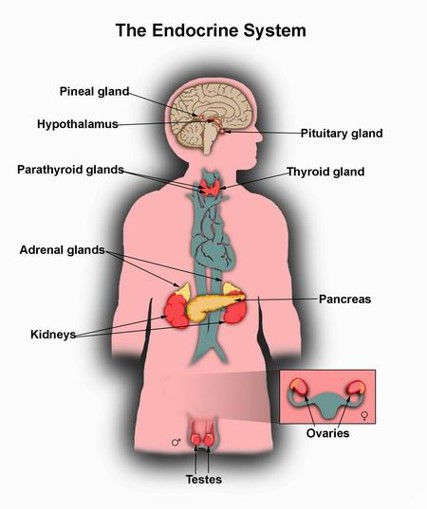
For example, the ovaries in women will release oestrogen which is essential for their reproductive cycle. Similarly the testes (in men) will release testosterone which is also responsible for maintaining their reproductive systems. Another example is the pineal gland which releases the hormone melatonin which induces sleep. You’re probably asking at this point – how does this relate to psychology and human behaviour? It’s important to know that as well as biological effects, hormones have behavioural effects too. For example testosterone has been related to increased levels of aggression, and varying levels of oestrogen and progesterone have been correlated with sex drive, irritability and aggression. And these are just a few behavioural consequences of a few hormones!
I would recommend you know at least 2-3 hormones, which glands they are produced from and the behavioural and biological effects of these. It is very possible that you could be asked to describe the effects/ role of a hormones so make sure you are prepared!
Differences between nervous system and endocrine system
Fight or flight: the stress response
Now we are going to look into more detail about the biological process behind a really important survival response: how we respond to threat.
Any time your senses detect something that the CNS registers as a threat or some form of stress, your nervous system and endocrine system both kick into action. Both systems are involved, and this is what we mean when we say that the stress response is a neuroendocrine response. Remember evolutionary theory from when we studied the biological approach in the approaches topic? This is the idea that we have some innate, adaptive responses and behaviours that help to keep us alive. These behaviours enabled our survival in the course of evolution, and because they are genetic they are still with us today (even if it’s debatable whether or not they are actually adaptive any more!).
The main intention of the fight or flight process is to ensure we survive. Back in caveman times this would involve running away from the threat (a sabre toothed tiger?) or standing and fighting it (the cavemen from over the hill trying to steal our food?). Imagine the fight or flight response as being a temporary super power which makes you quicker, stronger and more aware of your surroundings. So, in evolutionary terms, the cave people who had this genetic fight or flight response were much more likely to survive. Whereas the people who didn’t have this genetic superpower (biological response) didn’t have a good chance of survival and were more likely to die out. This is why we still experience this process whenever faced with a threatening or stressful situation.
Below is a diagram of this process:

I would also recommend listening to the YouTube clip below, which talks you through the stages above.
Finally, even though this is a biological process, and all the biological steps definitely happen within the body, we still need to do a bit of evaluation. Why? Well, it’s because even though we understand the biology of it, we still have to evaluate whether we understand the behaviours / response fully. For example, is the response really a ‘fight or flight’ response or is it more complicated than that? Below is some evaluative evidence and discussion.
Evaluation of fight or flight
“Fight or flight” was a phrase coined by Cannon (1915), who was a physiologist seeking to explain behaviours seen in the face of a threat. In the years since, this concept has been developed further. Scientists discovered that there is another behavioural response to threat – freezing, i.e. a temporary inability to move. This is often seen in prey animals, where it has been termed ‘playing dead’. Gallup (1977) referred to it as ‘tonic immobility’. Most of the research has been done in animals, but there is evidence that this is seen in humans also.
Gray (1988)
Jeffrey Gray, a neurobiologist, researched the psychology of anxiety and fear. Using evidence from many sources, he updated fear response theory. While he identified that individuals respond to fear in seemingly different ways, there is an underlying system that governs our response. He called this part of human personality the FFFS (fight flight freeze system). He proposed that the freeze response is an instinctive response with the aim of avoiding confrontation: a period of hypervigilant stillness, which allows the person to weigh up the situation and decide how to act.
Further evidence of the freeze response in humans
- Tonic immobility has been observed in a lab study, where researchers measured physiological response to induced stress in individuals with PTSD (Vochan et al, 2011).
- A review of the literature analysing the reported experience of victims of sexual violence provides strong confirmation of the freeze response in humans (Galliano et al, 1993).
What does this tell us? That ‘fight or flight’ does not explain all stress responses observed. This has powerful implications for the legal cases, for example: the idea that if you didn’t fight or run, you weren’t really a victim, and your attacker could not have known that you were experiencing fear. This is an outdated idea but sadly it’s still recycled in many court cases.
Taylor et al (2000)
These researchers pointed out a historical gender bias in fight or flight research – much of the research had been conducted on males, both in human studies and in animal studies (i.e. male rats). Taylor et al reviewed a large body of literature and concluded that in fact the behavioural responses of females are different. Rather than ‘fight or flight’ behavioural responses they saw that females exhibited ‘tend and befriend’ responses. It is still a stress response – there is stimulation of the SNS, the SAM, the release of adrenaline and all the same physiological stress responses, but the behavioural response is different.
‘Fight or flight’ = fighting the threat, or running away from it
‘Tend and befriend’ = protecting offspring, and forming alliances
What does this tell us? That ‘fight or flight’ as a concept has a gender bias, with potential for creating misconceptions in society about norms for responding to fear/stress. Androcentrism (ie focus on males) in the research led to beta bias: psychologists assumed that females responded in the same way as males, until Taylor provided evidence of a tend and befriend response. This has lots of real-world implications: in terms of recognising individuals who need help/support, and identifying and supporting victims of crime in an appropriate way.
Article going into more detail about tend and befriend- worth a read!
Huttunen, Kokko and Ylijukuri (2004)
These researchers tracked Finnish winter outdoor swimmers. The cold induced a stress reaction, activating the SNS and causing the release of stress-related hormones. After four months, the swimmers reported a significant decrease in tension and fatigue, and an improvement in mood and memory, compared to non-swimmers.
What does this tell us? This type of repeated stress response may lead to improvement of general well-being. There may be potential for therapeutic applications of this knowledge. However, this does not take account of gender or individual differences, and is not as yet well enough understood to be able to use the stress response to our advantage.
Read the article for more information: study showing how winter swimming improves general well being
A maladaptive response?
While the fight or flight response may have been a useful survival mechanism for our ancestors, who faced genuinely life-threatening situations (e.g. from predators), modern day life rarely requires such an intense biological response. However, we still have the same genetic responses as our caveman ancestors. The stressors of modern day life can repeatedly activate our fight or flight response, and this can have a negative consequence on health. For example, if you experience a lot of stress you will spend a lot of time with an active SNS, which increases your blood pressure (in preparation for a burst of caveman activity). If this happens a lot, you can have issues with your blood vessels and heart disease. Another problem you can have if you experience a lot of stress is that you seem to catch every cough and cold going round. This is because stress hormones suppress your immune system. It makes sense if you’re a caveman – it makes sense not to spend energy fighting off a cold if you are about to have to fight off a predator. The fight or flight response made sure that our caveman ancestors ‘spent’ their energy in the best way to survive until nighttime. However, modern life isn’t like that. If you are stressed over a long period of time you may find that you experience more illness, due to your stress hormones suppressing your immune system.
This suggests that the fight or flight response is a maladaptive response in modern-day life.
 CGS Psychology Blog: Mrs Harris