
Cognitive Approach
The cognitive approach provides the ‘missing-link’ left by the behaviourists, that mental process between stimulus and response. What happens between receiving information about our environment and acting upon it. To fill in this gap, the cognitive model generally adopts an information processing approach, comparing mental functions to the latest developments in computer hardware.
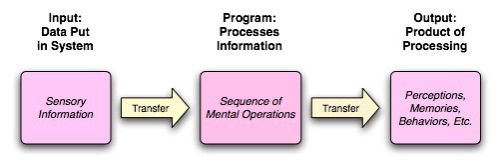
The main features/beliefs of the cognitive approach are:
- Behaviour is influenced by thoughts that can be both conscious and non-conscious – internal mental processes.
- Mental processes are information processing and the processing can be compared to that of a computer.
- Models can be used to provide testable theories about mental processing and these can be studied scientifically and inferences made.
- Cognition and biological processes can be integrated leading to cognitive neuroscience as a way forward to understanding human behaviour.
- Methodology – use of controlled experimentation – inference about mental processes on the basis of observed behaviour.
Schemas (strictly speaking schemata)
Schemas are the basis of our ideas. Faced with a novel situation we can rely on existing schemas as a guide. I may not have been to a wedding before but I still have expectations of what will happen; a bride, a groom, a ring, speeches, dad dancing and a punch up in the car park! Strictly speaking our schemas for events are called scripts. Those for groups of people are called stereotypes. When faced with a novel situation or unfamiliar face they allow us to make snap decisions with little or no mental effort.
Strengths of schemas:
- schemas help us predict what will happen in our world based on our experiences
- schemas enable us to process vast amounts of information rapidly
- schemas prevent us from becoming overwhelmed by environmental stimuli.
Weaknesses of schemas:
- schema can distort our interpretation of sensory information
- schema lead to perceptual errors or inaccurate EWT / memories
- schema can cause biased recall / see what we expect
- negative / faulty schema may have a negative impact on mental health
As you may see from the problems with schemas, they are not always ideal, and it’s important for schemas to develop and change. Jean Piaget believed that we change schemas all of the time as children. For example, if a child sees a chicken for the first time it will learn the schema that all chickens have feathers, a beak, wings and claw like feet. When the child sees a duck for the first time they may call it a chicken. They have applied the schema, but it doesn’t fit. The child will then develop a new schema that learns that ducks are birds that live in ponds and have feathers and a beak etc.
Stereotypes are the perfect example of where schemas can go wrong. They may be based on previous experiences, but they are not always accurate. Schemas may not change due to people disregarding information that doesn’t fit neatly into existing schemas whilst focusing on that that does.
How the Cognitive Approach studies behaviour:
The cognitive approach utilizes controlled experiments to understand cognitive processes. The mind is unobservable, you cant open up someone’s brain and see what they are thinking in little speech bubbles. We can only infer cognitive processes by observing behaviour and talking to people.
Inference is a key aspect of the cognitive approach. This involves going beyond the immediate evidence to make assumptions about mental processes that cannot be directly observed.
For example, one piece of research which we will cover in the memory course is a study by Loftus and Palmer.
Loftus and Palmer (1974)
EXPERIMENT 1:
Loftus had a sample of 45 American students recruited via a self-selected sample – advertised at he university – could potentially earn course credit. All participants were shown the same 7 film clips of different traffic accidents which were originally made as part of a driver safety film.
After each clip participants were given a questionnaire which asked them firstly to describe the accident and then answer a series of questions about the accident. There was one critical/leading question in the questionnaire: “About how fast were the cars going when they hit each other?” One group was given this question while the other 4 groups were given the verbs “smashed’, ‘collided’, ‘contacted’ or ‘bumped’, instead of ‘hit’.
Results: Mean speed estimates in mph for the verbs used in the critical/leading question
Smashed 40.8
Collided 39.3
Bumped 38.1
Hit 34.0
Contacted 31.8
Conclusion: It was concluded that Response bias had occurred – The verb used in a question doesn’t influence the memory of the event, but instead influences a participant’s response i.e. the way a question is phrased influences the answer given. The leading question is used as a clue, which leads them to answer in a particular way.
This is an example of where the cognitive approach uses a highly controlled lab experiment in order to make inferences about memory. Although we can be pretty sure that the verb caused the participant to increase their speed estimate, we cannot know this for sure. This is because our minds are unobservable. In inference also means that it is simply an interpretation, this means there could be other reasons for the speed increase. For example, the driving experience of the participants could have influenced the accuracy of the speed given, and not the verb!
Evaluation of the Cognitive Approach
Strengths:
- Scientific methods: The cognitive approach attempts a scientific explanation and adopts a scientific methodology. Because it uses scientific methods its theories and assumptions are testable and more objective than those of the psychodynamic approach. For example the study by Loftus & Palmer and all of the studies within the MSM such as Peterson & Peterson and Baddeley. They all use lab experiments in order to understand the cognitive process of memory. This is a key strength of the cognitive approach because there is a high degree of control over variables which means that cause and effect can be established. In addition, variables are operationalised to make measurements accurate and objective. Standardisation of procedures means research can be replicated to enhance reliability.
- Useful Applications: Cognitive psychology has numerous applications. As part of the memory topic we will learn about the cognitive interview technique for improving Eyewitness Testimony. Kohnken et al. (1999) – Carried out a meta-analysis of 42 studies and found that the Cognitive Interview gave consistently more accurate information in comparison to the Standard Interview. Improves credibility of the technique. This means that police departments and courtrooms can improve the accuracy of testimony and ensure a fair trial. Research has supported its effectiveness in increasing amount and accuracy of recall. In addition, during the psychopathology unit we will learn how the cognitive approach has been widely applied in the treatment of depression and anxiety and stress disorders. CBT (cognitive behaviour therapy) combining cognitive and behaviourist approaches tackles the thought processes behind unwanted or abnormal behaviour. David et al (2008) Using 170 patients suffering from major depressive disorder that were treated using REBT had better outcomes than those treated with anti-depressants 6 months after treatment. This makes the treatment more useful because it ensures that the individual does not need to return to be treated again.
- Further useful applications: The cognitive approach spurred the development of Cognitive Neuroscience which has been used to gain even further insight into how the mind and brain are connected. Previously the mind was seen as separate from the brain, but now it is the common belief that they are very much intertwined. As you can see from the notes above, Cognitive Neuroscience have many useful applications. For example, Use of scanning/imaging techniques eg to locate different types of memory in different areas of the brain leading to treatment for memory problems
- Further Useful Applications:
- Point: A strength of the cognitive approach is its proven usefulness in the real world. Evidence: For example, the cognitive approach has led to the development of CBT and REBT which according to David et al (2008), results in better outcomes for those with major depression disorder than those treated with anti-depressants 6 months after treatment. Explain: CBT and REBT work by changing sufferer’s negative and faulty thought processes, which is hinged on the cognitive explanations of behaviour. Consequence: As a consequence, the cognitive approach is a benefit not just for psychology but for society on the whole, as it has led to the emotional support of many people suffering from mental health, providing them with a better quality of life and helping them to contribute more effective to the society we live in. Challenge: However, CBT, may not be effective in addressing all mental health issues, e.g. hallucinations in schizophrenia. Therefore, this suggests that the cognitive approach may not always be usefully applied in all cases.
- Point: One strength of the cognitive approach is its practical applications. Evidence: Research by Beck et al. (1979) demonstrated the effectiveness of CBT in treating depression by targeting and changing negative thought patterns. Explain: This supports the idea that cognitive interventions can bring about positive changes in behaviour. Consequence: Consequently, the practical applications of the cognitive approach enhance its credibility and relevance and strengthens its position as a valuable framework in psychology, with implications for improving individuals’ well-being. Challenge: However, critics argue that the cognitive approach oversimplifies complex mental processes and neglects the influence of emotions and social factors on cognition. Therefore, the practical applications that derive from the cognitive approach may not always be successful.
Weaknesses:
- Alternative Explanations: A weakness of the cognitive approach is the alternative explanation of the biological approach to explain behaviour. Early Cognitive psychologists place an emphasis on the concept of the mind and how the internal mental processes cause behaviours. For example, Beck’s negative triad explains that negative thought processes are what lead to symptoms of depression. In comparison, Gottesman (2010) found that the risk of mental illness was much greater for children who had of two parents with a diagnosis of bipolar, thus suggesting that there is likely to be a biological element to the development of mental disorders, which isn’t considered by early cognitive psychology. As a consequence, this suggests that the cognitive approach doesn’t provide a full enough explanation of all behaviours and that other approaches needs to be considered with cognitive theories to ensure their accuracy. However (this point must be included!) it can be argued that the later development of cognitive neuroscience resulted in the integration of the mind and brain working together to cause behaviour, allowing for a more interactionist perspective and therefore a more accurate depiction of the causes of behaviour.
- Internal mental processes aren’t observable (unscientific- use as a challenge) However, it is worth recognising that there are aspects of this approach which could be argued to be less scientific. Internal mental processes are located within the mind, which is an unobservable concept, therefore suggesting that regardless of highly controlled lab studies, the approach is still lacking in the empirical method, a feature of science.
- Subjectivity of the approach: The main disadvantage of the cognitive approach is that it refers to cognitive processes that we cannot directly observe. It relies heavily on inference. Critics of Loftus and Palmer’s leading questions experiments pointed to the validity of the re constructive memory hypothesis, as we cannot be sure that memory has changed as the researchers couldn’t observe memories, but only the answers given – which may have been the result of demand characteristics, or even poor judgement of speed. Therefore, the cognitive approach may lack being scientific on the basis that it is subjective in what is taken from findings. Assuming that findings are the result of invisible processes is heavily subjective and therefore the internal validity being raised as issues.
- Reductionist: A weakness of the cognitive approach is it takes a reductionist perspective of behaviour. Lab studies and a high control of variables mean that the psychologist tend to only be looking at one aspect of behaviour at a time, rather than how many factors interact to cause a behaviour. As a consequence this may mean that the approach misses the complexity of human behaviour and context behind behaviour and therefore might not be as accurate when explaining certain phenomena.
- Nomothetic approach: whilst these theories have been developed to be applied to the wider population, it can be argued that this doesn’t apply to everyone and taking a nomothetic approach isn’t an accurate way to apply psychological knowledge. Craik & Watkins suggest that elaborative rehearsal, where you connect a memory to a previous memory, results in the greatest recall therefore suggesting that a more idiographic approach to applying the cognitive approach would be better.
- Low ecological validity due to high use of lab experiments: Artificiality of the situation impacts on ecological validity; ecological validity often affected by narrowness of dependent variables so that sight is lost of behaviour as a whole. Studies such as Loftus and Palmer and Peterson and Peterson use artificial stimuli – eg nonsense words / ambiguous figures, and this means that the approach may not be an accurate explanation of behaviour when applied to real situations of cognitive processes such as memory. In addition, the awareness of participation means people taking part may exhibit demand characteristics which could affect the validity of the research. If the research to support the approach can be questioned, then the credibility of the cognitive approach can also be questioned.
Cognitive Neuroscience
Brings psychology into the twenty first century! It combines our study of behaviour and the very latest understanding of the brain. Cognitive Neuroscience is the Scientific study of brain/neurological structures, mechanisms, processes, chemistry and understanding how these aspects of the brain are responsible for certain cognitive/mental/thinking processes.
Early examples go back to the nineteenth century and the work of Paul Broca and Karl Wernicke who isolated areas of the left hemisphere of the brain involved in language production and understanding respectively. We will also look at the working memory model of STM that has shown there to be links between executive functions and the prefrontal cortex.
Modern scanning techniques such as fMRI are allowing for ever-more detailed analyses of brain areas and combined with other experimental techniques is allowing for an unprecedented understanding of the links between brain function and behaviour.
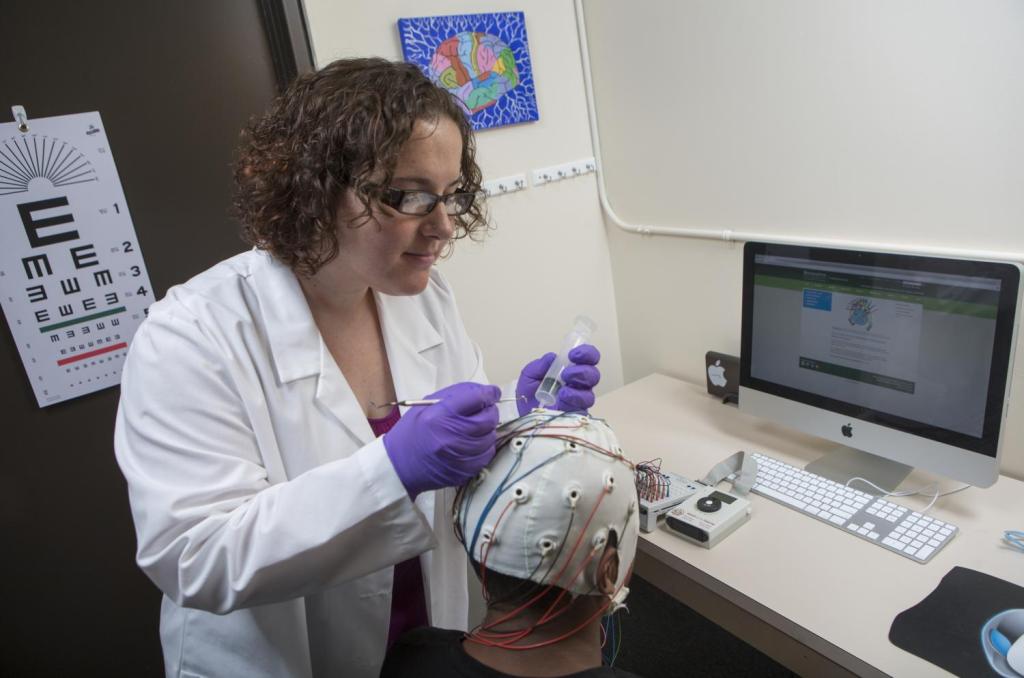
Cognitive Neuroscience has many practical applications including:
- Use of scanning/imaging techniques eg to locate different types of memory in different areas of the brain leading to treatment for memory problems
- Use of scanning/imaging techniques to study mental processing patients with depression or OCD or in children with autism or dyslexia
- Use of imaging techniques and angiography to study the effects of normal ageing on the brain or to observe the effects of stroke on the brain
- Use of computer simulations/computational modelling to test theories or hypotheses about mental processes such as attention, memory, problem solving etc
- Use of computer modelling to develop voice recognition programmes
- Use of eye-tracking/motion-tracking to study visual word processing and reading
Studies within the course that link to cognitive neuroscience:
Memory:
- Tulving also used brain scans as evidence for the nature of different long-term memory stores. PET scans found that episodic and semantic memories were associated with the prefrontal cortex. The pre-frontal cortex is in both the left and right hemisphere of the brain. The left pre-frontal cortex was found to be responsible for the semantic memories and the right pre-frontal cortex responsible for episodic memories. It is also thought that procedural memory resides in the cerebellum. This should come as no surprise as the cerebellum (or little brain) has long since been known to be involved in fine motor coordination, necessary in many skills.
- Belleville et al (2006) found that episodic memory could be improved in older people who have a mild cognitive impairment.
- Evidence supports the existence of separate stores in STM through brain scanning evidence Braver et al gave tasks that involved the Central executive to Ppts while they were having a brain scan. They found that there was greater activity in the prefrontal cortex. Other research using PET scans has found that different parts of the brain are activated when doing a visual task compared to a verbal task. This supports the WMM because it provides evidence that the CE, PL and VSS exist as separate systems within the brain infrastructure.
Schizophrenia:
- Allen et al (2007) scanned patients with auditory hallucinations, compared to a control. A negative correlation was found – lower neural activation levels were found in superior temporal gyrus and anterior cingulate gyrus and were correlated with an increase in positive symptoms such as auditory hallucinations.
Forensic:
- Raine used PET scans to investigate the differences in neural activity in the brains of 41 ‘murderers’ (who were judged as Not Guilty for Reasons of Insanity (NGRI) this is due to having mental health disorders which ranged from Schizophrenia to brain damage or disease) with 41 controls non-murders. He found that Murderers had reduced activity in the Prefrontal cortex compared to controls – Linked to loss of self-control and altered emotion – violence. Murderers showed reduced activity in the limbic system – amygdala, thalamus and hippocampus. This part of the brain has been associated with aggression and memory, it could imply that less activity in this area increases aggressive behaviour, and they may not have a good enough memory to learn from their mistakes.
Evaluation of Cognitive Neuroscience
Outline and evaluate cognitive neuroscience (16 marks)
Cognitive neuroscience integrates our latest knowledge of the brain with behaviour. It looks at the brains processes and uses this to describe the reasons for our behaviour. It was a recent paradigm shift in psychology when the cognitive approach was shifted to cognitive neuroscience. It heavily involves the use of scans such as functional magnetic resonance imaging (fMRI), PET scans and EEGs or ERP. Cognitive neuroscience is a scientific method of looking at the internal mental processes that are involved in the brain between the input of the stimulus and the output of a response.
One strength of cognitive neuroscience is that it’s useful. The different scans used can be used to better understand mental illnesses such as depression. By using the scans such as an fMRI scan, we can see brain activity in response to different stimuli giving us and idea of the internal mental processes that we initially knew very little about. This is a strength of cognitive neuroscience as it has paved the way for targeted brain treatments. For example, by understanding that there is less activity in the front of your brain when suffering with depression, a new treatment was developed which sends electrical impulses that are directed to the front of the brain. This was shown to reduce symptoms and therefore, improve the quality of lives for those who haven’t responded to anti-depressants. A further useful application of cognitive neuroscience is that is has helped us to better understand memory. Braver found that were able to identify the different parts of the working model of memory through PET scans are and therefore targeted neuroplasticity can be implemented to help those with brain damage or memory loss.
One strength of the cognitive approach is that it is very scientific, for example EEGs use electrodes to measure brain activity which is very accurate and provides much more empirical evidence than an inference about the internal mental processes. For example, research using fMRI has revealed the brain regions involved in language processing, such as Broca’s area and Wernicke’s area. This is far more scientific in comparison to the cognitive approach. This is because inferences are made about internal mental processes, through observed behaviour, but this can be open to researcher bias. Brain scans are observable and non-interpretative, thus improving its scientific status in psychology. However, the cognitive neuroscience approach has limitations. One critique is that it often focuses on correlational rather than causal relationships between brain activity and behaviour. While neuroimaging techniques can show which brain regions are active during certain tasks, they cannot always determine whether activity in those regions causes the behaviour or is merely a consequence of it.
Additionally, an issue with cognitive neuroscience is that is is reductionist. Allen et al (2007) scanned patients with auditory hallucinations, compared to a control. A negative correlation was found – lower neural activation levels were found in superior temporal gyrus and anterior cingulate gyrus and were correlated with an increase in positive symptoms such as auditory hallucinations. This evidence highlights how cognitive neuroscience breaks down complex behaviors into their neural components as it suggests that the internal mental process of a hallucination can be attributed to a neural correlate within a certain areas of the brain. Consequently, cognitive neuroscience may oversimplify the richness and variability of human behaviour, and therefore may not provide a full understanding of behaviour. However, despite its limitations, the cognitive neuroscience approach offers valuable insights into understanding the neural basis of human behaviour. By combining neuroscientific methods with psychological theories, researchers can develop a more comprehensive understanding of how cognitive processes manifest in behaviour.
 CGS Psychology Blog: Mrs Harris