
According to the specification you need the know the following;
“The evolutionary explanations for partner preferences, including the relationship between sexual selection and human reproductive behaviour”
There are some words there which probably sound a bit confusing and overwhelming so lets break it down a bit.
The evolutionary explanations: meaning Darwin’s theory of evolution and survival of the fittest.
Partner preferences: What people look for when seeking someone to have a romantic relationship with or in evolutionary terms, when looking for a mate.
Sexual selection: strategies used to choose the best mate
Human reproductive behaviour: refers to the different behaviours that humans exhibit in order to increase their reproductive success
So, in a nutshell this subtopic is all about using the evolutionary approach to explain what people are attracted to, how they go about finding the best person and their perspectives on sexual relationships.
You will notice from these descriptions that this subtopic is very biologically based and resembles our behaviour to the animal kingdom. Hopefully, if we’ve taught you right, this is already screaming some GRAVER SAUNDERS alarm bells at you ready for evaluating this explanation of relationships later on.
Darwin and Relationships
Darwin noticed that evolution favours the development of certain features that are deemed attractive to the opposite sex.
These traits/ features or characteristics are usually indicators of good fertility and success and therefore mean that if you mate with that person your genes will be passed on and offspring will survive.
The evolutionary approach makes assumptions/ theories about behaviour & relationships that are centred around the aim of reproduction and passing on genes.
In short- Evolutionary approach states that the purpose of relationships is to produce offspring and pass on our genes. As a result of this, many of our behaviours are shaped from the genes we have inherited from our ancestors.
Anisogamy and Behaviour
This is the differences between male and female sex cells (also known as gametes)
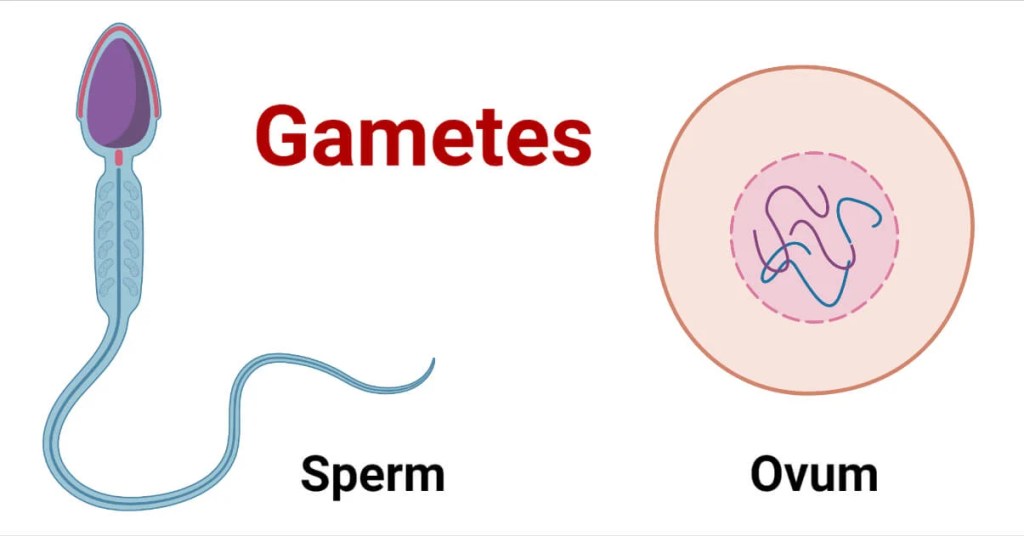
Female gametes: (Eggs) Large/ static/ produced at intervals of a monthly cycle. Only fertile for short amount of years (comparatively) and require lots of energy to produce (in comparison to sperm)
Male gametes: (Sperm) small/ highly mobile/ produced in large quantities from teens to old age. Doesn’t require a lot of energy to produce (in comparison to an egg)
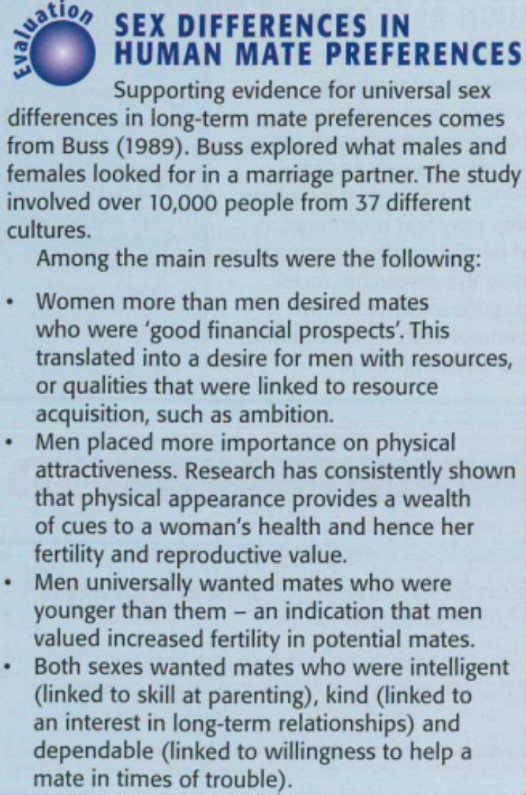
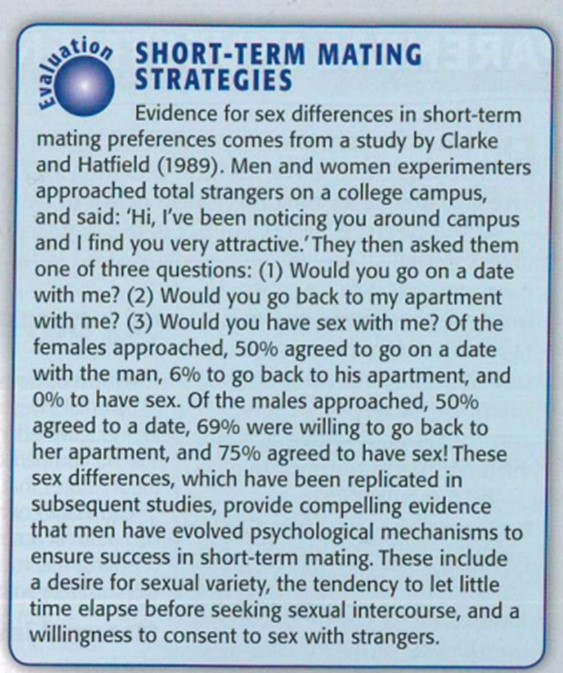
Because of these differences, women and men are said to view having sex in different ways. Because of the ease that men can reproduce, they want to have lots of sex with lots of different women. This is so they can “sow their seeds” as much as possible to get optimum reproductive success. Women, on the other hand, have to think carefully about who they mate with. They have a limited number of eggs a month and across a lifespan and when pregnant have to invest 9 months before they can get pregnant again (at least!) They don’t want to have loads of sex in case they end up with a baby with rubbish genetics. They want to make sure they mate with someone who has good genes to pass on, can provide for them and wants to provide for them.
This has happened through evolution because the men who felt the desire to have loads of sex, produced the most offspring and then passed that genetic behaviour onto his offspring. Women who were selective about who they mated with produced babies who were more likely to survive and thrive and therefore those genes were passed on. According to evolutionary psychologists, this is why we see the gender differences in choosing partners and how men and women behave towards the opposite sex.
Differences in Partner Preferences
| Males | Females |
| Indicators of Youth and Fertility. (Waist- Hip Ratio- see below) Maybe nurturing behaviours, caring qualities etc | Resources (Money and Shelter) Kindness, Loyalty, Generosity |
Waist to Hip Ratio (WHR): In 1993, Devendra Singh suggested that WHR represents a strong predictor of women’s physical attractiveness.
The ideal figure is not completely dependent on social influence, but rather derived from a numerical ratio, namely the waist-to-hip ratio (WHR).
If does not matter whether a person is fat or slender, the ideal relation should approximate 0.7.
This value is calculated by dividing the waist circumference by the hip circumference.
Example: 63 cm of waist circumference by 90 cm of hip circumference which makes 0.7.
Why would males want a women with this specifically?
Indication of Health
Fertility success
Cue of the start of reproductive capacity
Current pregnancy
Number of previous pregnancies
Sexual Selection
As a result of these limitations, two types of sexual selection are developed. These are strategies that are used to optimise reproductive success.
Inter- sexual selection: between sexes.
Strategies males use to select females and females use to select males
Intra- sexual selection: within each sex
Strategies between men or between women to be the one selected.
To help you understand the differences between the terms above, I want you to imagine a scene. There is a group of men stood in a pub, in walks a female on her own.

Thinking of typical males stereotypes, the men might display certain behaviours which show off their resources (clothes they wear, watches, trainers, buying drinks), they might show off their physical strength (starting a fight, challenging others to an arm wrestle, boasting about time in the gym) or they might engage in conversation to show off a kind personality (telling jokes, complimenting her with top notch pickup lines – “Are you a parking ticket? Because you’ve got FINE written all over you”). This is Intra- Sexual Selection because the men are competing with each other to show off who is the better mate for the female.

In comparison the female in this situation would be assessing the options available to her and deciding who would be the best mate to choose. As seen below. This would inter-sexual selection. Some students in the past have remembered this as inter is INTER-national because they are looking across the other potential places to live and making a choice about where to go (or in this case who to mate with). This memory strategy is a bit of a stretch but works for some!

More detail on specific strategies to do this with these terms below, I would recommend you know at least 2 of these to be able to describe if asked an exam question on this.
Inter- Sexual Selection- Quality over Quantity
Mostly used by females as they have more to lose in mating with the ‘wrong’ mate. The strategy is for women to pick a mate who is genetically fit who is able and willing to provide resources.
Examples of Intersexual Selection are;
Sexy Sons Hypothesis: women select attractive husbands which will then produce attractive sons, who will then get more mating opportunities therefore increasing her reproductive success
Handicap Hypothesis: women will choose men who are handicap but still thrive regardless…. Why? The idea is that this shows resilience and strong genes in other areas because they have been successful regardless of difficulties they have faced. Surely someone who has faced adversity and overcame it, is going to be a better mate than someone who has had an easy ride?
Courtship: to select males on the basis of reproductive suitability. Essentially dating before engaging in sexual activities. Prolonged courtships is for the individual) to ensure a potential mate gives time, effort & resources and has all the qualities they are looking for before they get pregnant with the wrong person or get deserted wit an offspring.
Intra-Sexual Selection- Quantity over Quality
Preferred by males as victory over other males means they get to mate with the female
Explains Dimorphism, which is an obvious bio difference between men and women
Men had to fight with each other to gain the right to reproduce with the females. Larger males have an advantage and are therefore more likely to win, reproduce and pass on their genes to the next generation
Courtship/ mating rituals– to display genetic potential. the video below is some of the rituals used in the animal kingdom, whilst you watch this, can you see any similarities between animals behaviours and humans to show off reproductive superiority?
Mateguarding– In modern times this would be classed as controlling or manipulative behaviour. Where a man will closely watch or ‘guard’ the female to make sure not other make steals them or tried to mate with them. It’s an attempt to prevent Cuckoldry, where a female mates with one man for his genetic potential but tells another man it’s his so she can make use of his generosity and resources. (Sounds like something from EastEnders, I know…) If a man closely watches his mate then he is reducing the risk of this happening.
Sneak Copulation- when males mate with other females, whilst their current mate is pregnant. It’s in his interest to continue producing offspring but can’t do this with his current mate as she is already pregnant.
Basically, a good way of remembering everything covered so far is that according to the evolutionary approach, women are genetically wired to be gold diggers and men are wired to cheat and sleep around!
Research to support this explanation

Evaluation
Strengths
- Research to support is has been done with large samples, some using experimental methods and objective scientific data collection. (See Buss, Clarke and Hatfield and Millet et al above).
- Supports various modern relationships, such as older men with younger women and the gender bias surrounding casual sex. Explains why women are much more inclined to use makeup and have plastic surgery
Weaknesses
- There are flaws to the research methods used with studies that support. It’s very difficult to be certain of evolution and disregard the social construction of these gender differences
- Incredibly Alpha biased and biological deterministic
- Biologically reductionist as it ignored the social environment that could shape the behaviour rather than just genetics
- Doesn’t support the existence and success of single parent families, long distance relationships and the LGBTQ+ community. Very Heteronormative.
- Temporal validity: social changes may mean that the theory is outdated and no longer a validity reflection of todays society. For example, Berekei et al that women’s greater role in the workplace means that they are no longer dependent on men for resources. This means that mate preference may not be resource driven. This theory is very alpha biased and assumes that men and women are worlds apart when it comes to mate preference. However, in an ever changing society where social roles are less defined, this may not reflect mate preferences for a lot of individuals which limits it’s generalisability.
 CGS Psychology Blog: Mrs Harris