
Harlow:
Harlow, wasn’t really taken seriously when he talked about his research into the importance of love. Harlow wanted to study the mechanisms by which newborn rhesus monkeys bond with their mothers. These infants were highly dependent on their mothers for nutrition, protection, comfort and socialisation. Harlow’s explanation was that attachment develops as a result of the mother providing “tactile/contact comfort”, suggesting that infants have an innate (biological) need to touch and cling to something for emotional comfort.
Harry Harlow did a number of studies on attachment in rhesus monkeys during the 1950s. People were amazed at his findings and started to take him a bit more seriously.
You need to know this study for your exams. All the other studies are there for interest and wider reading.
Wire/Cloth mother experiment:
Procedure:
Harlow (1958) separated 8 infant monkeys from their mothers immediately after birth and kept them in isolation.
Independent variable:
The surrogate monkey was the independent variable. All 8 monkeys were placed into a cage with two surrogate mothers, one was made from wire mesh and dispensed food via a bottle, and the other was a cloth-covered surrogate mothers. Harlow wanted to investigate which of the two alternatives would have more attachment behaviours directed towards it
Dependent variable:
Harlow measured the amount time that monkeys spent with each surrogate mother and the amount of time that they cried for their biological mother.
Harlow also carried out a number of fear conditions where he placed strange or scary objects into the cage to see how the monkeys would behave. Finally, Harlow observed the long-term effects of the monkeys. He observed how they interacted with other monkeys once released from the cage, and observed their behaviour as mothers.

Results:
- The monkeys spent more time with the cloth mother compared to the wire mother, regardless of which one dispensed milk. The infant would only go to the wire mother when hungry.
- Once fed it would return to the cloth mother for most of the day.
- If a frightening object was placed in the cage the infant took refuge with the cloth mother and used it as a safe base. Once comforted the monkey would build confidence to explore the environment. Therefore, the cloth mother was more effective in decreasing the youngsters fear.
- The monkeys showed long term emotional consequences. Firstly, when the caged monkeys were mixed with socialised monkeys (i.e. brought up with other monkeys), many of them were aggressive and less sociable, and found it difficult to mate. Secondly, when cage reared monkeys became mothers themselves, they acted more cruelly towards their offspring, sometimes attacking, or even killing them. Harlow believed that the continual disruption of the attachment between infant and primary caregiver is extremely damaging, and he called this maternal deprivation.
Conclusions:
Harlow believed that ‘contact comfort’ was more important than food when it same to forming an attachment behaviour. He argued that this innate drive for comfort overwhelms and overshadows all other variables.


You don’t need to learn this second study. I have put this in because it is interesting due to its disturbing nature. I remember this study from my A levels! Scarred into my brain!
Isolation experiments:
Infant monkeys reared in isolation – He took babies and isolated them from birth. They had no contact with each other or anybody else. The monkeys were left in isolation for varying amounts of time:
- 3 months
- 6 months
- 9 months
- 12 months
He then put them back with other monkeys to see what effect their failure to form attachment had on behaviour.
Results:
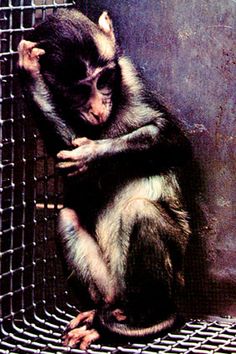
- The monkeys engaged in bizarre behaviour such as clutching their own bodies and rocking compulsively.
- They were then placed back in the company of other monkeys. To start with, the babies were scared of the other monkeys, and then became very aggressive towards them.
- They were also unable to communicate or socialise with other monkeys.
- The other monkeys bullied them.
- They indulged in self-mutilation, tearing hair out, scratching, and biting their own arms and legs.
- Those kept in isolation for 3 months and returned to a socialised group of monkeys were the least affected, but those in isolation for a year never recovered the effects.
Conclusions:
Like Lorenz (who we will cover next) Harlow concluded that there is a critical period of attachment in order to ensure normal development. He believed that an infant monkey had to be introduced to its mother within 90 days in order to ensure that an attachment is formed. If an attachment is not formed by this time, this lead to irreversible damage and an attachment would not be possible.
FYI:
Harlow did a wide variety of studies with the rhesus monkeys, including only allowing the monkey to access the wire mother or cloth mother. In some cases he left baby monkeys in bare cages. When he did this, he found that most of the babies died! However, when he gave them a blanket or something to cuddle, they survived.
If you would like to learn more about Harlow, I recommend that you watch the documentary below. It gives a fascinating insight to Harlow’s life outside of his research, but also allures to his darker experiments.
Lorenz:
Lorenz (1935) took a large clutch of goose eggs and kept them until they were about to hatch out. Independent variable: Half of the eggs were then placed under a goose mother so that they would hatch with the mother present, while Lorenz kept the other half beside himself in an incubator and made sure that he was present when they hatched.
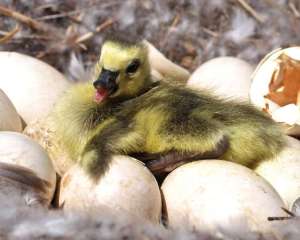
Dependent variable: Once hatched, the behaviour of all goslings was recorded.
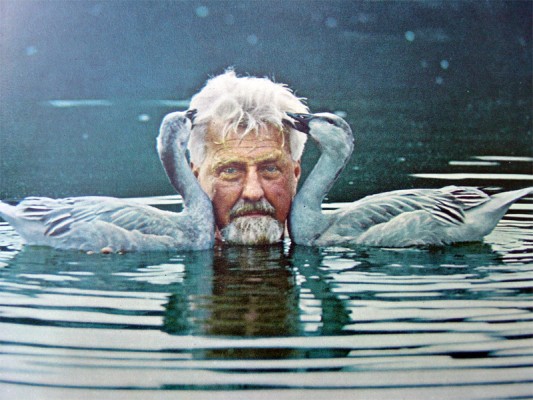
Findings: Lorenz put all the goslings together under an upturned box and allowed them to mix. When the box was removed the two groups separated to go to their respective ‘mothers’ – half to the goose, and half to Lorenz. Ethologists refer to the phenomenon as imprinting and it has the following characteristics:
- Critical Period. The attachment has to form within a certain time following birth. With ducklings the strongest tendency, according to Lorenz, is between 13 and 16 hours after emerging from the egg. If no attachment has developed within 32 hours it’s unlikely any attachment will ever develop.
- Irreversible: once the bond is formed it cannot be broken, nor can its effects.
- Template: the attachment acts as a template or model for later, adult and romantic relationships.
Imprinting has consequences, both for short term survival, and in the longer term forming internal templates for later relationships.
Sexual Imprinting
Refers to the inappropriate courtships in later life that may result from incorrect imprinting. Lorenz himself reported a few examples including a peacock that had become imprinted on a giant tortoise. When it reached maturity the peacock would attempt courtship with giant tortoises. Male Jays imprinted on Lorenz would bring him worms in later life in a vain attempt at courtship. Lorenz concluded that sexual imprinting had occurred i.e. an animal will look for a mate that is of the same species as the first animal that they saw at birth.
Evaluation:
Strengths:
- Applications: The research was of significant practical value, both in the treatment of other species in captivity and in parental neglect of human infants. The research highlights the need for good emotional care in early life and has proved invaluable in changing the way we treat animals and children. The research was ground breaking at the time. A common belief in the early 1900’s was that ‘a held baby, was a spoilt baby’ where children were often left in their cot and mothers were also told to stop coddling boys! I have attached an interesting article below which highlights some of the bad parenting tips given over the decades: https://www.redbookmag.com/life/mom-kids/g4109/worst-parenting-advice-through-the-decades/?slide=12 Harlow’s research was one of the first to break the traditional parenting values, which were unknowingly causing more harm than good!
- Further applications: social workers now understand the detrimental effects that child neglect and abuse can have on a child’s development and now have some idea on how the negative effects can be prevented. Social workers understand the importance of early intervention and preventing ongoing neglect in order to achieve the best chance of success. This has also been applied to animals who are kept in captivity.
Weaknesses:
- Ethics: It is clear that the rhesus monkeys suffered emotionally, not only in the short term but through into adulthood. They never fully recovered from their experiences. The reason Harlow chose monkeys was because of their position high up on the evolutionary scale. Some psychologists believe that what we learned about human deprivation was sufficient to warrant this suffering in monkeys.
- Generalisability: Lorenz’s research on birds doesn’t generalise to other mammals let alone humans. Mammals, especially those further up the evolutionary scale, tend to form more closer and more emotional bonds. They also have the ability to form attachments long after the critical period found in birds. We know that in Schaffer & Emerson’s research that children form specific attachments between 7-12 months old and the complexity of attachments are more complex due to the development of secondary attachments, which birds do not appear to have. However, they still seem to have a sensitive period, in which attachments are more likely to develop.
- Generalisability: The same limitation can be said for Harlow’s research. Humans are far more complex than monkeys, and although it may be argued to be a closer match than geese, there are still wide ranging differences between monkeys and humans. However, there are similarities in behaviour. Later in the course we will cover a piece of research by Mary Ainsworth called the strange situation. She found that babies will use the mother as a safe base when faced with new an uncertain environments e.g. cling to the mothers leg if a stranger enters the room. Once the baby has received comfort from the mother, the baby then has confidence to explore the environment. This was evidenced in Harlow’s experiments when he placed a monkey into an unfamiliar environment. The monkey jumped on the cloth mother straight away, but when the monkey felt comforted, they also felt comfortable to explore the environment. In addition, John Bowlby’s theory suggests that there is a critical period for developing an attachment (about 0 -5 years). If an attachment has not developed during this period, then the child will suffer from irreversible developmental consequences, such as reduced intelligence and increased aggression. (evolutionary theory). Therefore, there is evidence to suggest that the study can be generalised to human attachment.
- Validity: Guiton et al (1966) disagreed with the irreversible nature of imprinting that Lorenz put forward. They imprinted newly hatched chickens onto yellow rubber gloves (Marigolds if you prefer). In later life, just as the theory predicts, they did indeed try to mate with the gloves. However, when they had chance to spend time with others of their own species, they developed a ‘taste’ for mating with these instead.
 CGS Psychology Blog: Mrs Harris