
Behaviourism developed largely out of dissatisfaction with the psychodynamic approach and earlier theories of consciousness. John Watson (he of Watson & Raynor fame and Little Albert) wanted a theory of behaviour that was testable. The problem was in the early decades of the twentieth century there was no way of recording brain activity let alone mental processes. Result … ignore the workings of the brain, treat it as a black box, receiving information from the environment (stimulus) and creating a reaction (response). At its simplest behaviourist psychology is simply that: stimulus-response (S-R) psychology.
Behaviourists therefore believe that we are a product of our environment. At birth we are a ‘tabula rasa’ or blank slate. Our genetic make-up is largely ignored. Our personality, intelligence, achievements and behaviour are shaped by the environment in which we are reared. Behaviourism is therefore at the extreme nurture of the nature-nurture debate. However, like the psychodynamic theory it is determinist, seeing our outcomes as under the control of our environment rather than of our unconscious minds.
Behaviourism: Classical Conditioning
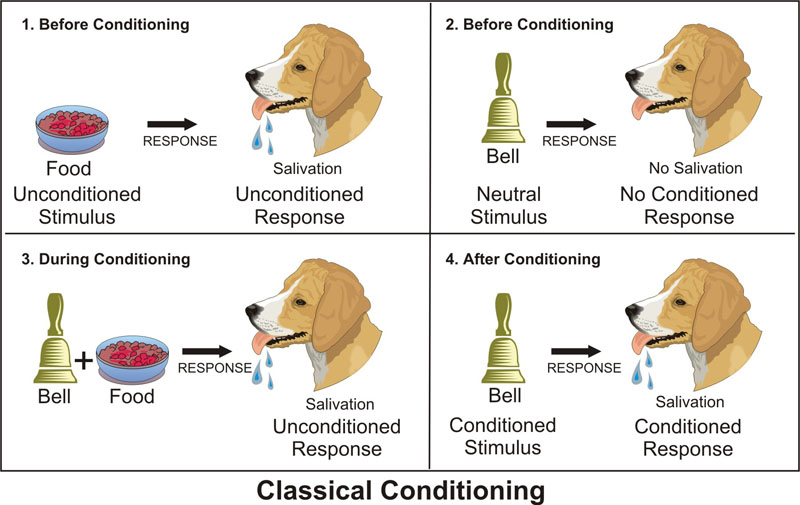
Pavlov noticed that his dogs would start to salivate when they heard the footsteps of the research assistant who they knew was going to feed them. Pavlov realised that the dogs had learned to associate food with the footsteps and wondered if this association would extend to other things, most famously the ringing of a bell.
Although the terminology seems daunting, if you just remember that conditioning refers to learning it helps.
The NEUTRAL STIMULUS (NS) is something that you would typically have little to no reaction to, in Pavlov’s case it is the BELL. The UNCONDITONED STIMULUS (UCS) is something that would usually create some form of response, in Pavlov’s case the unconditioned stimulus in the FOOD. The UNCONDITIONED RESPONSE (UCR) is one that does not require learning, such as a reflex. In Pavlov’s case it is SALIVATION. You do not learn to salivate to food, it happens naturally from birth. When the NS is paired with the UCS this produces the UCR. This pairing can happen once, or many times, either can lead to a conditioned behaviour. If the association has been conditioned. The NS now becomes the CONDITIONED STIMULUS (CS) and the UCR now becomes the CONDITIONED RESPONSE (CR). In Pavlov’s case, every time the dog hears the bell (CS) it leads to salivation (CR).
Watson carried out a study which wanted to investigate if a fear could be learned through the process of classical conditioning. Watson decided to use a young baby called Albert as the participant.
In the case of Little Albert, the NS was the rat and this was paired with the UCS of a loud bang and the UCR is being frightened. Once the NS and the UCS was paired again and again, this lead to the rat becoming the CS and being frightened as the CR. Albert was then terrified whenever he was in the presence of a rat. He even became scared of things that were fluffy and white and this is known as GENERALISATION.
Watch the video below to see footage of both the little Albert study and Pavlov’s study:
The cruelty of Pavlov
Despite the jokes, ‘that rings a bell’ etc. and Pavlov’s fluffy image as a man that made his dogs salivate to the sound of a bell, his research was quite unpleasant. The dogs were clearly mistreated and fitted with surgically fitted catheters to collect every drop of saliva.
Evaluation of Behaviourist Research:
- Point: Skinner’s research using rats in operant conditioning experiments has useful applications. Evidence: In Skinner’s classic experiment, rats were placed in a “Skinner Box” where they could obtain food by pressing a lever. Skinner observed that the rats would learn to press the lever more frequently when the behaviour was followed by a reward, such as food. This demonstrated the principle of operant conditioning, where behaviour is influenced by its consequences. Explain: Skinner’s findings were foundational in showing that behaviour can be shaped and maintained through reinforcement. This concept has had broad applications in various fields, including education, behavioural therapy, and animal training, illustrating the power of reinforcement in modifying behaviour. Consequence: Consequently, Skinners research has enabled positive change in society e.g. using behavioural therapy for a phobia, can help to improve the quality of life of sufferers. Challenge: However, the controlled conditions of the Skinner Box may not accurately replicate the diversity and complexity of human behaviour. As a result, while Skinner’s research was groundbreaking in understanding basic behavioural principles, its application to human psychology may be limited due to these oversimplifications, and therefore may not always provide useful applications to humans.
- Point: Skinner’s research on rats has faced criticisms regarding its generalizability to human behaviour. Evidence: Critics argue that the controlled environment of the Skinner Box and the use of rats as subjects may not fully capture the complexity of human behaviour. Explain: The research may lack generalisability because the simplicity of the Skinner Box setup may not address the nuances of human decision-making and behavior. Human actions are influenced by a range of factors including emotions, social context, and cognitive processes that were not represented in Skinner’s experiments with rats. Consequence: Consequently, this raises questions about the extent to which findings from rat studies can be extrapolated to human behaviour. Therefore, further research incorporating more complex and varied human factors is needed in order to develop a more comprehensive understanding of behaviour.
- Point: Skinner’s use of animal subjects in his experiments has been criticized for ethical reasons. Evidence: The Skinner Box, while effective for studying operant conditioning, involved confining rats in a controlled environment where their behaviour was manipulated extensively. Explain: This is unethical because this approach raises ethical concerns about the welfare and treatment of animals in research settings. Ethical considerations in research are crucial, and the use of animals in experiments must be balanced with their well-being. Consequence: As a consequence, the ethical debates surrounding Skinner’s experiments reflect broader concerns in the field of psychology about the balance between scientific inquiry and the humane treatment of animals.
Practice identifying the NS, UCS, UCR and CS and CR.
This is a typical exam question that you will be asked, and it is essential that you use behaviourist terminology. The answers are at the bottom of this blog page.
- Suzy goes outside to play in her tree house. A swarm of bees has nested near her house, and she gets stung several times when she climbs up to the tree house. This happens 3 times in a week. Suzy then becomes afraid to go near the tree and cries violently when her dad tries to get her to climb up to the tree house.
- Jerry’s wife, Mary, gets a new nightgown and wears it whenever she is in the mood for sexual relations. After a month, the sight of the nightgown alone is enough to excite Jerry
- A student went on holiday and was eating some peanuts on the plane. Whilst he was eating the peanuts, the plane malfunctioned and crashed. The student survived the plane crash, but whenever the student sees peanuts, he gets anxious.
- While caring for a friend’s dog, you notice that it displays a fear-like posture as you roll up a newspaper. You try this several times more and become convinced that this dog is generally afraid of rolled-up newspapers. You must infer on your own what happened to make this dog afraid of rolled-up newspapers.
- Joan, an animal trainer, has been phobic about monkeys since an earlier attack. However, because of the money, she has agreed to work with monkeys for a movie studio. At first, just going anywhere near the cages makes Joan tense, sweaty and apprehensive. Lately, though, things have changed. Working with such cuddly, affectionate, human-like creatures is causing Joan to wonder why she ever felt such extreme distress. Identify what original NS, UCS, UCR, CS, and CR were to make Joan afraid of the monkeys. In addition, identify the processes of counter-conditioning (what made her no longer afraid of monkeys).
- Bill visited a restaurant in the beginning of November and ordered the chicken. Afterwards, he became extremely sick and nauseated. Ever since then, he has been unable to even think about chicken without becoming nauseated. He went to his mums for dinner who had cooked a turkey. He was quite surprised to find that he felt slightly nauseated to the smell and sight of the turkey. However, he didn’t feel nauseated to the smell or sight of the roasted duck his cousin brought to the dinner. Identifying all of the processes, you should also be able to identify at least 2 principles.
Behaviorism: Operant Conditioning
Burrhus Frederick Skinner is known for developing a theory called operant conditioning. Skinner carried out research on rats and pigeons in his Skinner boxes to support his theory.
Students are often confused about the difference between these two forms of conditioning.
- Classical conditioning is simply the associative learning = Pavlov
- Operant conditioning involves learning through consequences = Skinner
To discover the precise effect of reinforcement and punishments on behaviour Skinner would observe animals in laboratory conditions where environments could be tightly controlled.
Operant conditioning: Positive Reinforcement
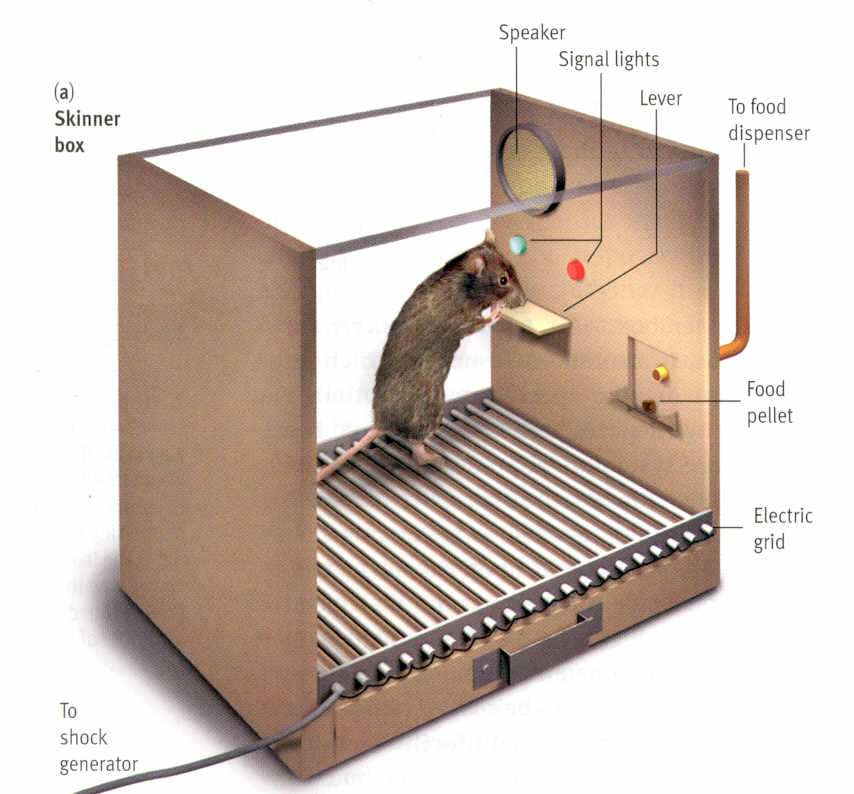
Skinner showed how positive reinforcement worked by placing a hungry rat in his Skinner box. The box contained a lever on the side, and as the rat moved about the box, it would accidentally knock the lever. Immediately it did so a food pellet would drop into a container next to the lever.
The rats quickly learned to go straight to the lever after a few times of being put in the box. The consequence of receiving food if they pressed the lever ensured that they would repeat the action again and again.
Positive reinforcement is where a reward encourages a behaviour.
Typically positive reinforcement is used to encourage desirable behaviour. For example, giving my dog a treat every time he waits at the curb before he crosses the road. However, sometimes positive reinforcement can encourage undesirable behaviours. For example, if a toddler is screaming and having a tantrum in a supermarket and the parent gives the child a sweet to be quiet. The child will be encouraged to have a tantrum in the hope that they will be given a sweet again!
In this video we see an example of positive reinforcement with Penny and punishment with Lenard.
Operant Conditioning: Negative Reinforcement
Negative reinforcement doesn’t always mean that something bad happens. A negative reinforcer is something that takes away an unpleasant consequence in order to encourage a behaviour. For example, taking paracetamol that takes away a headache. The removal of the unpleasant headache makes the behaviour that preceded it, taking paracetamol, more likely in future.
Skinner showed how negative reinforcement worked by placing a rat in his Skinner box and then subjecting it to an unpleasant electric current which caused it some discomfort. As the rat moved about the box it would accidentally knock the lever. Immediately it did so the electric current would be switched off. The rats quickly learned to go straight to the lever after a few times of being put in the box. The consequence of escaping the electric current ensured that they would repeat the action again and again.
Extinction
This is when a previous learned behaviour is unlearned. Skinner found that after the rats had learned to press the leaver to receive food, he could get the rats to unlearn this behaviour. Skinner stopped feeding the rat when it pressed the lever. After the rat had experienced no food after pressing the lever several times, the rat eventually stopped pressing the lever. The rat eventually learned that the behaviour had no reward, and therefore stopped doing it.
The difference between Reinforcement and Punishment
Reinforcement: anything that increases the chances of a behaviour being repeated
Punishment: anything that discourages and decreases the likelihood of a behaviour being repeated
Types of reinforcers:
Primary reinforcers are ones that satisfy a biological need, for example food, drink, sex.
Secondary reinforcers are reinforcers that we have come to associate with primary reinforcers.
- Money: will buy us primary reinforcers
- Promotion: will get us more money so we can buy primary reinforcers
- Exam success: will help us get promotion so we have more money…
Other secondary reinforcers would include smiles, compliments, gifts etc. Secondary reinforcers are every bit as powerful as primary reinforcers.
Evaluation of the behaviourist approach
- Point: There is research to support behaviourism. Evidence: Skinner carried out am experiment with caged rats, where he rewarded the rats with food, every time they pushed a lever. Eventually this behaviour became more frequent and deliberate. Explain: This demonstrates positive reinforcement as it shows that the reward of food, encouraged the rat to repeat the new behaviour of pushing a lever. Consequence: Consequently, due to having supporting research, the behaviourist approach can be seen as more credible. This allows researchers to more confidently apply behaviourism to society to make positive change. For example, teachers using positive reinforcement in schools to encourage good study habits. Challenge: However, whilst the study supports operant conditioning, the use of animals to support behaviourism may reduce the applicability to human behaviour. Although there is some evidence that behaviourism applies to humans, it is clear that humans are far more complex, so behaviourism may not provide a full explanation of human behaviour.
- Point: A strength of behaviourism is that it focuses on studying phenomenon which is observable and measurable. Evidence: For example, Skinner was able to prove that a rat could learn through positive reinforcement, as the introduction of food, showed a direct change in the rat’s behaviour i.e. pushing a lever. Explain: Having observable behaviour to support a theory is a strength because it allows researchers to understand behaviour in an objective way. Consequence: Consequently, the emphasis the behaviourist approach has placed on scientific processes such as replication and objectivity has helped improve the credibility and status of psychology, helping to establish it as a science.
- Point: One weakness of the behaviourist approach is that it is highly deterministic. Evidence: For example, Skinner himself said that free will is an illusion. In addition, in his experiment, he showed that the rat’s behaviour of pulling the lever was a direct result of the reinforcement. Explain: This demonstrates environmental determinism as it sees all behaviour as being determined by past experiences and conditioning. Consequence: As a result, we cannot be certain that the approach gives us an accurate and varied explanation of human behaviour which accounts for the impact of free will.
- Point: One strength of the behaviourist approach theory of classical conditioning has proven influential and has real life application. Evidence: Two treatments for phobias, systematic desensitisation and flooding, are based upon the idea of classical conditioning and have been successful in helping individuals overcome their irrational fear by forming a new association with the stimulus. Explain: This shows that behaviourism is useful because it highlights how the principles of conditioning have been successfully applied to a broad range of real-world behaviours and problems, for example the likes of phobias and abnormal behaviour. Consequence: Consequentially, this theory has been shown to have positive implications within society, improving people’s wellbeing and helping them to manage their future behaviours positively.
- Point: Another problem with the behaviourist approach is that it is highly reductionist. Evidence: For example, Pavlov argues that our behaviour is the result of simple stimulus-response associations that we have made over the years. Pavlov also isolates variables in his experiments to support his theory of classical conditioning. Explain: This is reductionist because it does not consider the cognitive and social factors that have an influence over our behaviour. It instead simplifies behaviour by reducing behaviour to simple learning processes, Consequence: As a result, we cannot be certain that the behaviourist approach gives us an accurate and varied explanation of human behaviour which can account for all behavioural phenomena.
Social Learning Theory (SLT)
SLT burst onto the scene in the early 1960s, half a century after Watson and co had established behaviourism as a major force in psychology. Being the new kid on the block it is sometimes referred to as neo-behaviourist.
The founding father was Albert Bandura who believed that we learn by imitating others and that learning takes place in a social context.
Bandura believed that behaviour was a result of observing a role model and imitating their behaviour. He aimed to prove his theory using his Bobo doll experiment.
Mediational Processes:
A good acronym to explain the mediational processes of SLT is ARRM:
- Attention – You need to pay attention to the behaviour of the model first
- Retention – You need to remember the behaviour that the model did
- Reproduction – You need to be able to replicate the behaviour of the model
- Motivation – You want to display the behaviour that was learnt from the model
Social Learning theory: Vicarious Reinforcement
There is also a type of reinforcement for Social Learning Theory called Vicarious reinforcement. Be really careful with this in exams. Students have often confused this with positive reinforcement. If you notice the exam question talking about observing a role model being rewarded, this is vicarious reinforcement.
Vicarious reinforcement occurs when (a) an individual observes another person (a model) behave in a certain way and experience a consequence perceived as desirable by the observer, and (b) as a result, the observer behaves as the model did. For example, a student who hears the teacher praise a classmate for effort on a 16 mark essay, she particularly loves the use of the PEEC structure. The student who overhears may then put a great deal of effort into their next 16 mark essay in the hope that they will also receive praise from their teacher.

Albert Bandura and the Bobo doll (1961)
Research method: This was a laboratory experiment which used an matched-pairs design.
The independent variables (IVs) were:
(i) Whether the child witnessed an aggressive or a non-aggressive adult model in the first phase of the experiment (a control group was not exposed to an adult model).
(ii) The sex of the model (male or female).
(iii) The sex of the child (boy or girl). The dependent variable (DV) was the amount of imitative behaviour and aggression shown by the child in phase three.
Sample: 72 children (36 boys, 36 girls), aged 37-69 months (mean 52 months), from Stanford University Nursery School. Participants were matched through a procedure which pre-rated them for aggressiveness. They were rated on four, five-point rating scales by the experimenter and a nursery school teacher, both of whom were well acquainted with the children.
Procedure:
Phase 1:
Children in the experimental conditions were individually taken into a room and sat at a table to play with potato prints and picture stickers for 10 minutes whilst:
– The aggressive model began by assembling a tinker toy set but after about a minute turned to a Bobo doll and spent the remainder of the period physically and verbally aggressing it using a standardised procedure.

– The non-aggressive model assembled the tinker toys in a quiet manner, totally ignoring the Bobo doll.
– The control group did not participate in Phase 1.
Phase 2:
All the children were then taken individually to an another room and subjected to mild aggression. Initially they were allowed to play with some very attractive toys including a fire engine, doll set and spinning top, but after about two minutes the experimenter took the toys away saying they were reserved for other children.
Phase 3:
Children were then taken individually into a third room which contained both aggressive and non-aggressive toys e.g. 3ft high Bobo doll, a mallet, dart guns and non-aggressive toys e.g. tea set, cars, dolls. They were observed through a one-way mirror for 20 minutes whilst observers recorded behaviour with inter-scorer reliability of .90 i.e. A very high concordance rate – therefore high reliability.
Results:
- Children in the aggressive condition showed significantly more imitation of physical and verbal aggressive behaviour and verbal responses than children in the non-aggressive or control conditions.
- Children in the non-aggressive condition showed very little aggression, although results were not always significantly less than the control group.
- Boys imitated male models more than girls for physical and verbal aggression, non-imitative aggression and gun play.
- Girls imitated female models more than boys for verbal imitative aggression and non-imitative aggression.
- Overall boys produced more imitative physical aggression than girls.
Evaluation of Bandura:
Strengths:
- Used a lab experiment and therefore very standardised reducing the chance of extraneous variables. All participants went into the same rooms, used the same toys and were in each room for the same amount of time.
- Quantitative data was collected and therefore is was easy to compare the level of imitated aggression across the conditions i.e. same sex model (control, aggressive, non-aggressive) opposite sex model (control, aggressive, non-aggressive) etc.
- The experiment was set out as a play room, very similar to their own nursery, therefore increased ecological validity.
- From this study there is a great understanding of how easily aggressive behaviours are imitated. This could lead to practical applications such as putting violent TV programmes to later times at night or changing age certificates on certain films etc.
Weaknesses:
- Due to the use of a lab the study lacked realism, hitting a Bobo doll is very different from hitting a person and therefore the researchers should be cautious when applying results to real life.
- Only collecting quantitative data meant that the researchers were not able to understand what the children were thinking or feeling during the study.
- Use of children can raise ethical issues as they cannot give consent and they find it more difficult to withdraw. Consent was gained from the school as they were doing activities usual of nursery day to day life. However, children were deliberately annoyed by researchers as part of the second stage of the experiment, this could raise potential issues of distress.
- Playing with a strange adult in an unfamiliar room is not a typical everyday task, ecological validity can be questioned.
- The study had a large sample size, however, when they were broken down into the conditions, there are only 6 participants, any confounding variables could have quite a large effect on the validity of the results.
Evaluation of Social Learning Theory:
- POINT: There is research to support SLT. EVIDENCE: For example, Bandura exposed nursery children to one of the 3 conditions; aggressive or passive role model or a control group with no role model. He further divided this down into opposing or same gender role model and child and matched his participants into these groups based on pre-rated aggressiveness. His results showed that children were more likely to imitate a same-sex role model. EXPLAIN: This supports SLT because it demonstrates that exposure to role model can determine children’s behaviour in a future event and highlights where individuals learn behaviours by observing the consequences of others’ actions. CONSEQUENCE: Consequently, this suggests that SLT is a credible theory when explaining the causes of behaviour and therefore we can be more confident in applying the theory to making positive changes in society. For example, exposing children to positive role models in order to encourage desirable behaviour. Challenge: However, the study utilised a very small sample and was carried out in lab conditions. Therefore, this weakens the support for SLT because if the study has low external validity, we can’t be sure that SLT would provide an accurate explanation to children outside of the study in everyday environments such as at home.
- Point: (A) However, it is important to remember that there are alternative explanations of behaviour that could explain human behaviour. Evidence: For example, the biological approach might suggest that boys in the Bandura study were more physically aggressive due to having higher levels of testosterone compared to the girls. Explain: This means that explaining behaviour as being a result of role model exposure isn’t a full enough explanation on its own, as it could be a mixture of nature and nurture. Consequence: Consequently, explaining behaviour from only the perspective of SLT might lead to inaccuracy and a lack of accuracy when applying SLT to the real world, given that the nature side of behaviour is being ignored by SLT.
- Point: (U) Social learning theory has many useful applications in society. Evidence: For example, Ansager et al. (2006) found that identification with a character or example may increase the likelihood that audiences will model behaviour presented in an anti-alcohol message. Explain: This research example demonstrates that by understanding the power of role models, this can be used to help society with a variety of different issues, such as making better life style choices, increasing career efficacy for underrepresented groups, or helping individuals to overcome challenges of poor mental health. Consequence: Consequently, this highlights the importance of SLT as if it can help to understand human behaviour in the case of alcohol use, it suggests that we could implement further interventions to encourage other desirable behaviours such as respect and kindness.
- Point: (N) A further strength of SLT is it takes a nurture stance of behaviour which can be useful when developing interventions. Evidence: For example, this theory explains behaviour as a result of exposure to role models and how that exposure is mediated through mediational processes. It is assumed that having observed a behaviour, we are likely to imitate this and alter our behaviour as a result. Explain: This demonstrates that the theory takes a nurture perspective of behaviour because the cause of change is present within the environment and isn’t something we inherent or are born with. This is a strength because by recognising our behaviour is caused by external stimuli, we are able to intervene and present children with desirable role models. Consequence: As a consequence, this will have a positive impact on the behaviour for future generations, as more people are aware of the impact that their behaviour has on young minds. Challenge: Furthermore, SLT benefits from taking a soft deterministic approach. This means that is believes that behaviour can be determined by role models, but the mediational processes allow for an element of freewill. This is beneficial when applying the SLT to society as it places an element of responsibility to the individual, and it also highlights that people have the capacity to change.
- Point: Another strength of social learning theory is its ability to explain the role of cognition in learning, which other behavioural theories often overlook. Evidence: Social learning theory includes concepts such as attention, retention, reproduction, and motivation, all of which are cognitive processes that mediate between observing behaviour and replicating it. Bandura emphasized that individuals must be motivated and able to recall what they observe before they can reproduce the behaviour. Explain: By incorporating cognitive factors into the learning process, SLT moves beyond simplistic stimulus-response models and provides a more nuanced understanding of how people learn. This is particularly important when explaining complex behaviours, such as problem-solving, moral development, or social skills, which cannot be easily explained by conditioning alone. Consequence: Thus, SLT’s inclusion of cognitive processes makes it a more robust and comprehensive explanation of human behaviour compared to other learning theories that ignore these factors.
- Research in support: Bandura’s Bobo doll into imitation of aggression. Bandura also replicated research where children watched aggression on a TV, and imitation still occurred. In addition, Fox and Bailenson (2009) found that humans were more likely to imitate computer-generated ‘virtual humans’ who were similar to themselves. These studies demonstrate support for different aspects of SLT, including modelling and vicarious reinforcement, adding credibility to the key principles of this theory.
- Not completely Scientific: Mediational processes are unobservable concepts, therefore psychologists have to make inferences using observable indicators of behaviour. As a result this questions how scientific the theory is and therefore how accurately it reflects and explains behaviour. It also has difficulty demonstrating cause and effect – although Bandura research controlled variables and demonstrated behaviour was imitated it is difficult to show cause and effect in real life due to the lack of testability and control.
- Soft Determinism: This means that if an individual observes a role model, and the correct mediational processes are followed (attention, retention, reproduction motivation) SLT predicts that you will repeat this behaviour. Although the mediational processes imply some level of freewill, it still assumes that role models have a strong influence in determining behaviour. Therefore, SLT cannot account for all behaviour, because our choices may influence our behaviour more than the approach assumes.
Answers for the scenarios:
- Suzy: NS = Tree house, UCS = Getting stung; UCR = Pain (fear of getting stung); CS = Tree house; CR = Fear.
- Jerry: NS = Nightgown, UCS = Sexual activity; UCR = Arousal because Mary is in the mood for sex; CS = nightgown; CR = Arousal.
- Student: NS = peanuts, UCS = Plane Crash; UCS = Fear because of plane crash; CS = peanuts; CR = fear.
- Friends dog: Your friend is hitting the dog with a rolled-up newspaper. NS = rolled up newspaper, UCS = Getting Hit; UCR = pain (fear) of getting hit; CS = rolled up newspaper; CR = fear.
- Joan: Original Conditioning: NS = Monkeys, UCS = Attack; UCR =Pain (fear of attack); CS = monkeys; CR = fear of monkeys. Counterconditioning: UCS = Affection and Cuddling; UCR = good feeling because of affection and cuddling; CS = monkeys; CR = good feeling toward monkeys.
- Bill: NS = chicken, UCS = Food poisoning; UCR = becoming sick due to poisoning; CS = chicken; CR = becoming nauseated at thought of chicken. Bill is experiencing stimulus generalisation because the turkey is very similar to his original CS of chicken. However, the duck is not similar enough to chicken to produce stimulus generalisation and therefore, Bill is experiencing stimulus discrimination with the duck.
 CGS Psychology Blog: Mrs Harris