
As I’m sure you are aware, the body does lots of really amazing complicated stuff. It fights off the infections whenever you feel unwell, it makes use out of the food you eat and turns it into energy and according to the biological explanation of behaviour it tells you how to behaviour to ensure optimum survival. Metaphorically speaking you could think of your body a bit like a (sometimes) well running country or army. Now, to be able to keep this army running effectively, there is going to need to be a system of communication to ensure that all divisions of the army are doing the same thing with the same aim. This communication system needs to be quick to accommodate for the rapid changes in the environment (temperature, approaching threat, depleted resources). To cope with these changes your body uses the two communication systems- Nervous System and Endocrine System- to be able to cope with the body’s constantly changing needs.
The Nervous System
A good way to think of this system is like the telephone system we have in modern life. To be able to understand this i need you to imagine the following;
Neurotransmitters are the information being passed along.
Neurons are the telephone poles that pick that information us and send it onto the next one until it eventually reaches the part of the body that needs to process that information and use it. The reason why we can’t just send it straight to that part of the body is that over longer distances- hand to brain for example- the information loses it’s electrical impulse (charge in other terms) and needs to be recharged to push it along.
So let put this into a biological example;
You put your hand on a really hot plate. Your body need to get the information from your hand to your brain, so that your brain can tell your hand to take it off the hot plate, right?
Below are the stages of how that happens;
- You hand touches the hot plate.
- Neurotransmitters are sent from the end of your fingers, via neurons, to reach your spinal cord and then your brain.
- Your brain processes this information and decides that you need to take your hand off the plate
- neurotransmitters are then sent from neuron to neuron, out of the brain, along the spinal cord, into the muscles in your arm and hand.
- The muscles in your arm and hand then move this part of your body off the hot plate.
- Problem solved!
It seems weird that this isn’t just an automatic response. The reason why it’s difficult to imagine is because of the speed that it happens at, and that it is happening in our body without us even realising or feeling anything (other than the burning sensation on our fingers). To be honest though, would you want to feel and know every single message that is being sent round your body at any given point? The human brain has approximately 86 billion neurons, and that is just the brain.
So that is the basic run down of how the nervous system works, we do more on that specific process in the page call synaptic transmission and a later lesson. Wouldn’t want to overload you with too much information (or neurotransmitters, ha) too soon!
Now remember we said the nervous system is like a phone system, and the information being passed along needs to bounce from telephone pole to telephone pole to get to the final destination. If you wanted to call a relative that lives in America, you would need that information to pass through countries and even continents. The Nervous System consists of different parts that all have different roles and responsibilities and are located in different places. You can find a breakdown of that system below;

Central Nervous System (CNS):
As stated above, this is the umbrella term for the spinal cord and brain. The brain is where all the information ends up. It needs to then process this and decide what to do with this information and send it back down the spinal cord and to the relevant part of the nervous system.
Peripheral Nervous System (PNS):
So if you have the brain and spinal cord as the centre of your body, anything outside of these areas is what falls into the PNS. I remember this by thinking of your peripheral vision, which means everything around the outside edge of your vision. The Somatic Nervous System (SNS) controls muscle movement and receives information from the sensory receptors (what you are feeling, hearing, smelling, tasting and seeing at all times). The Autonomic Nervous System (ANS) is responsible for organs and ensuring vital functioning happens such as breathing, digestion and heart rate. This part also enacts the sympathetic or parasympathetic state, which we will move onto next.
These systems all work together to process the sensory information around you and determine how best to respond to that both biologically and behaviourally. For example, below is the example from above, with the added systems in bold;
You hand touches the hot plate. (Somatic)
Neurotransmitters are sent from the end of your fingers, (Somatic- part of the PNS) via neurons, to reach your spinal cord and then your brain. (CNS)
Your brain processes this information and decides that you need to take your hand off the plate (CNS)
Neurotransmitters are then sent from neuron to neuron, out of the brain, along the spinal cord, into the muscles in your arm and hand. (PNS- Somatic)
The muscles in your arm and hand then move this part of your body off the hot plate. (PNS- Somatic)
Finally, we have the sympathetic and parasympathetic branches/ states. This is where your body recognises there is a threat in the environment, this information is sent from your Somatic NS to your CNS, which processes there is a threat and then send this information down the spinal cord to the Autonomic NS. Here the ANS will have the following biological responses;
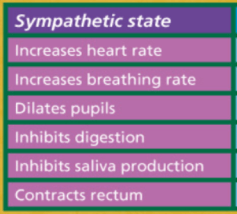
These biological responses are aiming to ensure any energy that is available, is send to deal with the increasing demand of the threat to ensure optimum survival. I’m going to use the metaphor of the body being run like an army. Say there is suddenly a opposition army about to attack one division of your body’s army. The army generals are not going to be worried about the cook continuing to cook tonight’s dinner or worried about keeping other reserves ploughing the fields. They are going to want to use all their soldiers to ensure optimal survival and defeat of the threat. This is what your body is doing, there is not need to continue digesting food or producing saliva as this is wasting energy on something that won’t help in this immediate action. Similarly, they want to stock their soldier up with enough weapons to ensure they can effectively fight back. This is resembled in the body increasing heart rate and breathing rate by pumping blood and oxygen to the muscles to enable a better, stronger chance of fighting or running away.
Once your body acknowledges that the threat has been avoided or defeated, your body will then revert back to it’s original state, the parasympathetic state/ branch, as characterised below;

The Endocrine System
The Endrocine system is still responsible for sending messages around the body however is does this through a different way and using different methods. The picture below shows the different glands in the body. Each of these release different hormones, through the bloodstream which have different effects on the body and other glands.

For example, the ovaries in women will release oestrogen which is essential for their reproductive cycle. Similarly the testes (in men) will release testosterone which is also responsible for maintaining their reproductive systems. Another example is the pineal gland which releases the hormone melatonin which induces sleep. Your probably asking at this point, how does this relate to psychology and human behaviour? Even thought these hormones have a biological function they also have behavioural effects too. For example Testosterone has been related to increased levels of aggression and varying levels of Oestrogen and Progesterone have been correlated with irritability and aggression. And these are just a few behavioural consequences of a few hormones!
I would recommend you know at least 2-3 Hormones, which glands they are produced from and the behavioural and biological affects of these. It is very possible that you could be asked to describe the effects/ role of a hormones so make sure you are prepared!
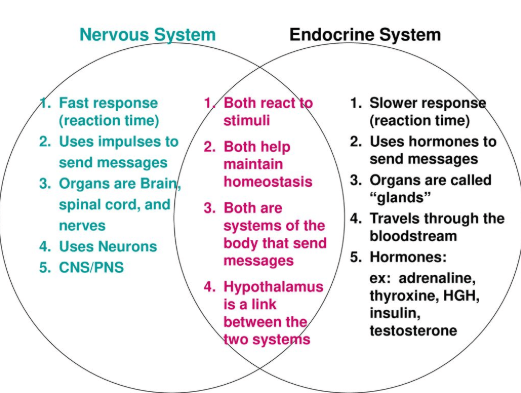
A good way of thinking of this system compared ot the nervous system is like sending a letter in the post. It is much slower than the nervous system, but the effects of it tend to last much longer (also it’s transported through the blood stream, royal mail is associated with red which might help you remember it the differences between them).
Differences between Nervous system and Endocrine System
Fight or Flight: A Stress Response
Now we are going to look into more detail about the biological process behind the sypathetic state and how the body responds to a threat.
Anytime your senses pick up on something that would be registered as a threat or some form of stress, your nervous systems and the endocrine system will kick into action to ensure you are best prepared for this. Remember the evolutionary theory from when we studies the biological approach in the approaches topic? This is the reason why are bodies process a threat in this way.
The main intention of the fight or flight process is to ensure we survive. Back in cavemen times this would involve running away from the threat or standing and fighting it. Whether this be a lion or another alpha male stealing our cave woman! Imagine that the fight or flight system is like a temporary super power which makes you quicker, stronger and more aware of your surroundings. So, in evolutionary terms, the cave people who biologically responded with fight or flight were more likely to survive as their body was redirecting energy production into this outcome. Whereas the people who didn’t have this genetic superpower (biological response) didn’t have the highest chance of survival and were more likely to die out. That is why, majority of humans and animals currently living will experience this process whenever faced with a threatening or stressful situation.
Below is a flow chart of this process;
 Colour Coding of flow chart:
Grey= Brain process
Blue- Nervous system
Red= Endocrine System
Green= Effects of Adrenaline
I would also recommend listening to the youtube clip below, which talks you through the stages above.
Finally, even though this is a biological process, some psychologists and biologists have disagreen with this explanations of how our body reactions to stressors in the environment. Below is some evaluative evidence and discussion which academics might use to question the explanation of fight or flight.
Evaluation of fight or flight
When faced with a dangerous situation our reaction is not limited to the fight or flight response; some psychologists suggest that humans engage in an initial ‘freeze’ response. Gray (1988) suggests that the first response to danger is to avoid confrontation altogether, which is demonstrated by a freeze response. During the freeze response animals and humans are hyper-vigilant, while they appraise the situation to decide the best course of action for that particular threat.
The fight or flight response is typically a male response to danger and more recent research suggests that females adopt a ‘tend and befriend’ response in stressful/dangerous situations. According to Taylor et al. (2000), women are more likely to protect their offspring (tend) and form alliances with other women (befriend), rather than fight an adversary or flee. Furthermore, the fight or flight response may be counterintuitive for women, as running (flight) might be seen as a sign of weakness and put their offspring at risk of danger.
Exam Hint: It is possible to incorporate knowledge of the issues and debates in psychology into your evaluation. For example, the above point is linked to the ‘Gender Bias’ topic and therefore you could explore the ideas of androcentrism and beta bias within this evaluation point. Early research into the fight or flight response was typically conducted on males (androcentrism) and consequently, researchers assumed that the findings could be generalised to females. This highlights a beta bias within this area of psychology as psychologists assumed that females responded in the same way as males, until Taylor provided evidence of a tend and befriend response.
Article going into more detail about tend and befriend- worth a read!
While the fight or flight response may have been a useful survival mechanism for our ancestors, who faced genuinely life-threatening situations (e.g. from predators), modern day life rarely requires such an intense biological response. Furthermore, the stressors of modern day life can repeatedly activate the fight or flight response, which can have a negative consequence on our health. For example, humans who face a lot of stress and continually activate the sympathetic nervous system, continually increase their blood pressure which can cause damage to their blood vessels and heart disease. This suggests that the fight or flight response is a maladaptive response in modern-day life.
Huttunen, Kokko and Ylijukuri (2004) tracked 49 Finnish winter swimmers who dipped in cold water an average of four times per week. After four months, they reported a significant decrease in tension and fatigue, as well as an improvement in mood and memory compared to 33 non-swimmers. Exposure to ice cold water induces a stress reaction, activating the sympathetic nervous system and increasing the secretion of hormones and neurotransmitters involved in fight or flight. Changes in the functions of both the autonomic and central nervous systems induced by the cold may have a role in the regulation of mood and pain threshold. Adaptation to cold by repeated exposures to cold water may increase the ability to withstand other kinds of stress. Improvement of general well-being via adaptation to oxidative stress is a benefit induced by regular winter swimming.
Read the article below for more information!
Study showing how winter swimming improves general well being
 CGS Psychology Blog: Mrs Harris