
The Role of Chromosomes and Hormones in Biological Sex:
What is the role of biology (specifically chromosomes and hormones) in sexual development? Let’s find out!
AO1 key definitions to learn:
Biological sex: The classification of an individual based on the physical and physiological attributes determined by chromosomes, hormones and reproductive organs that are typically associated with being male or female*.
Gender: Your psychological identity and the behavioural aspects of identifying as male, female or a non-binary individual.
*It can include intersex variations
Chromosomes:
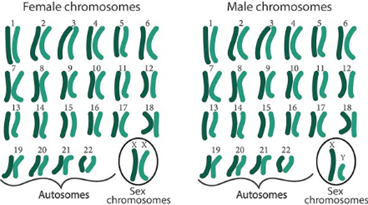
- 23 pairs of chromosomes inherited from the DNA of our biological parents.
- Our biological sex is determined by one of these pairs; the ‘sex chromosomes.’
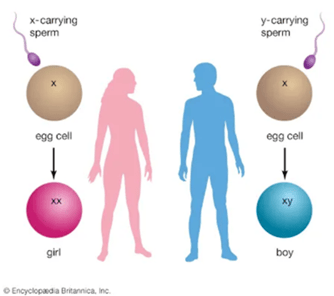
- A female embryo (XX) inherits one ‘X’ chromosome from the biological mother and an ‘X’ chromosome from the biological father.
- A male embryo (XY) inherits one ‘X’ chromosome from the biological mother and a ‘Y’ chromosome from the biological father.
- Only biological males (XY) can produce a Y chromosome
- It is the biological father’s genetic information that will determine the biological sex of the embryo.
- The Y chromosome is smaller than the X chromosome because it contains fewer genes.
- It includes the SRY gene (Sex-determining Region Y gene) which is what causes testes to develop in a male (XY) embryo.
Chromosomes influence the production of sex-related hormones, and these hormones in turn influence our sex-related development.
How do the following hormones contribute to our sexual development?
- Testosterone
- Oestrogen
- Oxytocin.
Testosterone
Known as an androgen (male sex hormone). Biological males have 10 times the level of biological females and it is released when the SRY gene is detected on the Y chromosome. Production of testosterone during 7th week of gestation leads to the development of male sex organs (testes & penis). Levels in biological males rise during puberty and affect physical traits such as body and facial hair, muscle mass and height. In biological females, most testosterone in the ovaries is converted to oestrogen.
Oestrogen
Although produced in both the testes and ovaries, oestrogen levels are much higher in biological females. Before birth, oestrogen promotes the development of the endocrine system in both males and females. Oestrogen Influences the development of secondary sex characteristics such as breast development and the menstrual cycle (ovulation). In biological males, it affects the development of male sex organs, erectile function and sperm cell production.
Oxytocin
Known as the ‘cuddle’ or ‘love’ hormone, oxytocin is produced by biological males and females. Levels are higher in biological females and higher again during and after childbirth. This hormone prepares the female body for childbirth and lactation to aid breast feeding. It also reduces stress hormones such as cortisol in both biological males and females.
Evaluating the Role of Chromosomes and Hormones in Biological Sex
Wang et al (2000) studied the link between testosterone and sexual development in a sample of 227 adult, biological males suffering from ‘male hypergonadism’. This is a condition whereby the body does not produce enough testosterone, sperm or both. These males had been struggling with low mood, libido, muscle mass and more. After 180 days of testosterone therapy, the participants reported an improvement in sexual function, an improvement in mood, and muscle strength.
What does this study suggest about the importance of testosterone in male physical development and biological sex?
Deeming and Ferguson (1989) arranged for the incubation of alligator eggs at varying temperatures to see how this affected biological sex when they hatched. They found that when the eggs were incubated at 30 degrees (C), 100% of the eggs produced biological females, and when the eggs were incubated at 33 degrees (C), 100% of the eggs produced biological males.
What does this study suggest about temperature and its influence on biological sex? Do the findings support or challenge the idea that chromosomes and hormones (nature) are the only important factors in the development of biological sex?
Wu et al (2012) studied the importance of the SRY gene in sex development. They administered an injection into mice to inhibit (silence) the expression of the SRY gene (located on the Y chromosome). They observed for testes production in the male mice but were unable to locate them. Instead, ovaries had developed. They concluded that feminisation of the male sex organs had occurred, despite the mice having XY sex chromosomes. Therefore, this study shows that chromosomes in general may not be the only factor that determines biological sex.
Koopman et al (1991) found that when the SRY gene from male mice was implanted into female mouse embryos, they developed physical traits typical of a biological male.
How does this experiment support the findings of Wu et al (2012) and the claim that chromosomes do not appear to be the only determining factor in biological sex?
Individuals with Complete Androgen Insensitivity Syndrome (CAIS) are biological males (XY) who do not respond to the production of testosterone. This results in the development of external female genitalia and undescended testes. These cases suggest that sex hormones, especially testosterone, may not be as influential on biological sex as first thought.
What does this suggest about the role of other biological influences more important than hormones?
Issues and debates
Can we criticise research into the role of chromosomes and hormones for focusing on the role of nature? Might it be more appropriate to consider the interaction between nature and nurture when understanding biological sex?
How is the research in this area biologically deterministic?
Real-world application
Caster Semenya was assigned female at birth but has XY sex chromosomes. She has 5-ARD, a condition where male reproductive organs do not appear externally during foetal development and the individual’s internal testes produce testosterone in the typical male range. Her case was brought into the spotlight when sports authorities banned her from competing in women’s events, sparking debates about biology and gender in athletics. World Athletics have since introduced stricter eligibility rules including mandatory SRY gene testing for female athletes in world ranking competitions.
As a society, how can we respond to differences in sexual development in sport?
And lastly…
What happens when some individuals have both male and female characteristics, known as ‘intersex’? There are over 1 million intersex people in the UK, which makes is as common as being a twin. Some people don’t ever discover they have a condition such as Kleinfelter’s Syndrome or Turner Syndrome. More on this next lesson!
Why might parents feel pressured to decide about the sex of their baby and opt for an early surgery? What might be the result of forcing parents to register their child’s birth as either male or female? What would you do if your baby was born intersex?
 CGS Psychology Blog: Mrs Harris